
The short version
- San Jose leads the world at $238,700 of GDP per person. Twenty-seven of the top 40 cities are American.
- Dammam is the only Middle East city on the list, at number 39 with $97,074.
- Dubai is not on it. On this measure that puts it below $96,958, even though it climbed nine places to 42nd in the same index's overall ranking.
- The reason is arithmetic, not weakness. Dubai's population grew 7.5% in 2025. Its economy grew 4.7% in the first nine months. Divide one by the other and the per-person number falls.
- If you are buying property here, the population number is the one that matters. People rent and buy homes. Output per head does not.
Richest cities in the world by GDP per person 2026: the full top 40
The ranking comes from Oxford Economics' Global Cities Index 2026. It takes each city's 2025 GDP, divides it by its population and shows the result in US dollars. Visual Capitalist published the top 40 on 5 October 2026. The full index scores 1,000 cities on economics, human capital, quality of life, environment and governance; this list is one slice of the economics data.
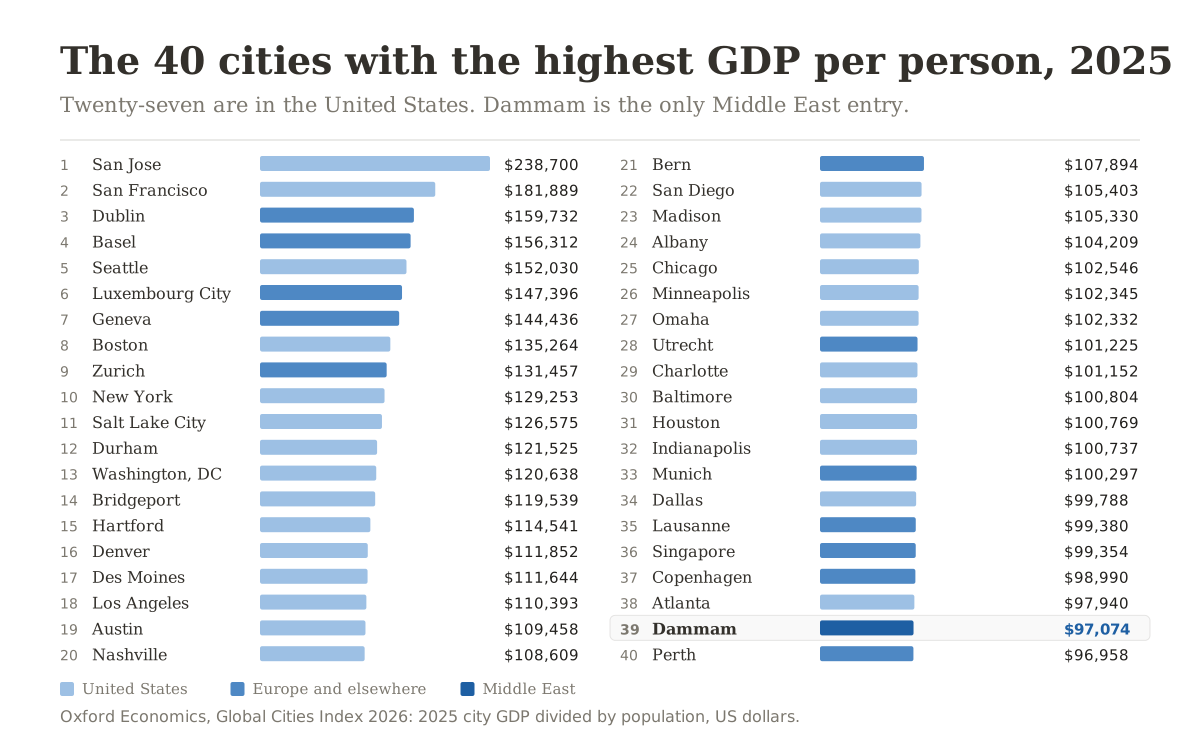
| Rank | City | Country | GDP per person, 2025 |
|---|---|---|---|
| 1 | San Jose | United States | $238,700 |
| 2 | San Francisco | United States | $181,889 |
| 3 | Dublin | Ireland | $159,732 |
| 4 | Basel | Switzerland | $156,312 |
| 5 | Seattle | United States | $152,030 |
| 6 | Luxembourg City | Luxembourg | $147,396 |
| 7 | Geneva | Switzerland | $144,436 |
| 8 | Boston | United States | $135,264 |
| 9 | Zurich | Switzerland | $131,457 |
| 10 | New York | United States | $129,253 |
| 11 | Salt Lake City | United States | $126,575 |
| 12 | Durham | United States | $121,525 |
| 13 | Washington, DC | United States | $120,638 |
| 14 | Bridgeport | United States | $119,539 |
| 15 | Hartford | United States | $114,541 |
| 16 | Denver | United States | $111,852 |
| 17 | Des Moines | United States | $111,644 |
| 18 | Los Angeles | United States | $110,393 |
| 19 | Austin | United States | $109,458 |
| 20 | Nashville | United States | $108,609 |
| 21 | Bern | Switzerland | $107,894 |
| 22 | San Diego | United States | $105,403 |
| 23 | Madison | United States | $105,330 |
| 24 | Albany | United States | $104,209 |
| 25 | Chicago | United States | $102,546 |
| 26 | Minneapolis | United States | $102,345 |
| 27 | Omaha | United States | $102,332 |
| 28 | Utrecht | Netherlands | $101,225 |
| 29 | Charlotte | United States | $101,152 |
| 30 | Baltimore | United States | $100,804 |
| 31 | Houston | United States | $100,769 |
| 32 | Indianapolis | United States | $100,737 |
| 33 | Munich | Germany | $100,297 |
| 34 | Dallas | United States | $99,788 |
| 35 | Lausanne | Switzerland | $99,380 |
| 36 | Singapore | Singapore | $99,354 |
| 37 | Copenhagen | Denmark | $98,990 |
| 38 | Atlanta | United States | $97,940 |
| 39 | Dammam | Saudi Arabia | $97,074 |
| 40 | Perth | Australia | $96,958 |
Why the United States holds 27 of the 40 places
The top of the list is a technology story. San Jose, San Francisco and Seattle rank first, second and fifth, and each is built around very large, very productive tech companies. San Jose's lead over San Francisco is about $57,000 per person. That gap is what Silicon Valley does to an average.
New York is tenth. It has a far bigger economy than almost everything above it, but this ranking does not measure size. It measures output per resident. That is also how Des Moines and Omaha get in.
Europe has ten cities on the list, and five of them are Swiss: Basel, Geneva, Zurich, Bern and Lausanne. London and Paris, second and third in the index's overall ranking, are not in the top 40 at all. Overall strength and output per head are two different questions.
The richest city in the Middle East: why Dammam, not Dubai
Dammam is the capital of Saudi Arabia's Eastern Province. Saudi Aramco is headquartered next door in Dhahran, and the province produces much of the kingdom's oil and gas. Book that output against a city of Dammam's size and the per-person figure climbs fast. It tells you about the structure of the economy more than about what residents earn.
Dubai, Abu Dhabi, Doha and Riyadh are all outside the top 40. At country level, the World Bank puts the UAE at about $50,300 a head. I went through that ranking, and why it says little about property, in the richest countries in the Middle East.
Where Dubai ranks in the Global Cities Index 2026
Oxford Economics published the 2026 index on 15 September 2026. Dubai and Riyadh entered the global top 50 for the first time. Dubai rose nine places to 42nd. Riyadh jumped 47 places to 50th. Abu Dhabi fell 11 places to 84th. All three are in the report's new "cities to watch" section, which names the places Oxford Economics expects to climb.
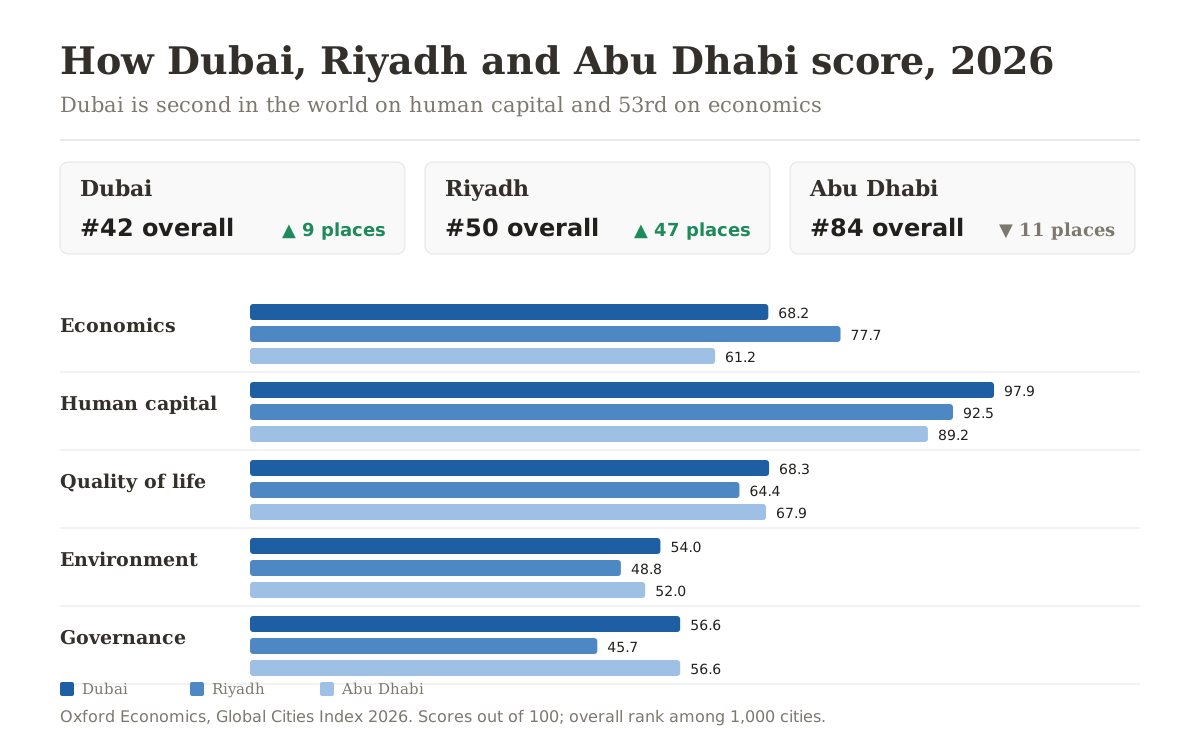
| Category | Dubai | Riyadh | Abu Dhabi |
|---|---|---|---|
| Economics | 68.2 | 77.7 | 61.2 |
| Human capital | 97.9 | 92.5 | 89.2 |
| Quality of life | 68.3 | 64.4 | 67.9 |
| Environment | 54.0 | 48.8 | 52.0 |
| Governance | 56.6 | 45.7 | 56.6 |
| Overall score | 79.6 | 78.1 | 73.2 |
| Overall rank (of 1,000) | 42 | 50 | 84 |
Dubai's strength is human capital, where it ranks second in the world. Coverage of the index credits part of that to the Golden Visa and retirement visa reforms. On economics it is 53rd, against Riyadh at 18th and Abu Dhabi at 110th.
Oxford Economics calls the regional conflict "a serious headwind" for these cities. It still expects them to keep climbing, citing their structural advantages and the sovereign wealth behind them.
Why Dubai's GDP per person understates the city
GDP per person is a fraction. Output on top, residents underneath. If the bottom grows faster than the top, the number falls while the economy grows.
That is exactly what happened in 2025. Dubai's population reached 4.58 million at the end of the year, up about 332,000, or 7.5%, according to the Dubai Data and Statistics Establishment. GDP for the first nine months was AED 355 billion, up 4.7%. Put the two together and output per resident fell roughly 2.6% in a year when the economy got bigger.
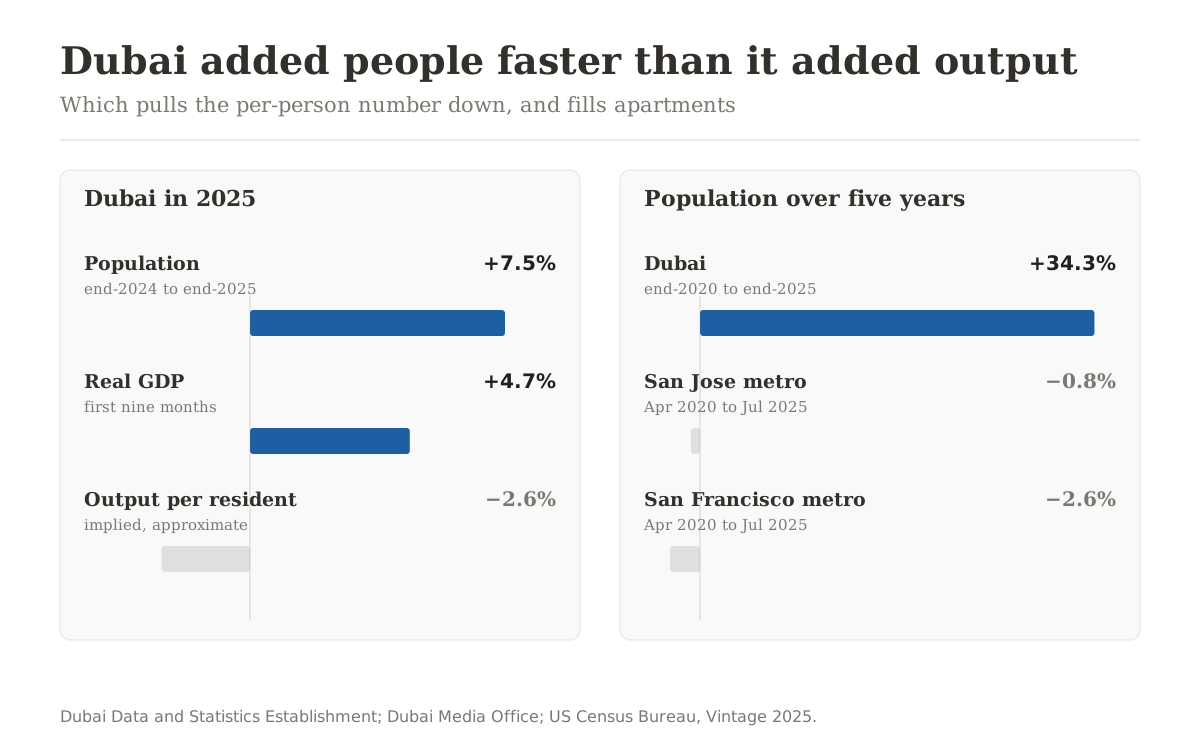
The top two cities on the list are moving the other way. US Census Bureau estimates put the San Francisco metro 2.6% below its April 2020 population in July 2025, and the San Jose metro 0.8% below. Over roughly the same five years, Dubai went from 3,411,200 residents at the end of 2020 to 4.58 million at the end of 2025. That is about 34% more people.
One more way to see it. The 332,000 people Dubai added in a single year equal about 40% of the entire population of the city of San Francisco, which the Census Bureau put at 826,079 in July 2025.
What this means if you are buying property in Dubai
Housing demand comes from people, not from output per head. A city with the highest GDP per person in the world and a flat or shrinking population is a harder place to find a tenant than its ranking suggests. I would watch three things instead:
- Population growth, and whether new supply keeps up with it. That demand shows up first in deals, prices and rents, which I track every month in my Dubai market update.
- Rent and yield, area by area. They are in the Dubai Rental Yield Index, and you can run your own unit through the rental yield calculator.
- The full cost of buying and holding, from the DLD fee to the service charge. It is all in my guide to buying property in Dubai as a foreigner.
Dubai's second place on human capital matters for rents too. It says a large share of new arrivals are skilled, well-paid workers, and they are the tenants of the city's mid-market and prime apartments.
Where I would be careful
- GDP per person is not income. It is a city's output divided by its residents. It says nothing about wages, the cost of living or how wealth is shared.
- Cities draw their borders differently. In Luxembourg, Basel and Geneva a large part of the workforce commutes in from neighbouring countries every day. Their output counts for the city; they do not count as residents. That lifts the per-person figure.
- Dubai counted its 2025 population with a new method built on administrative and real-time records, so treat the five-year comparison as indicative. The same office puts the average daytime population at 6.39 million.
- Every figure here is for 2025. The effect of the regional conflict that began on 28 February 2026 is not yet in official population data. I will update this piece when the 2026 numbers are out.
My take
The richest-cities list tells you where each person produces the most. It does not tell you where people are going. Dubai is missing from it because it is adding residents faster than its economy is adding output, and for a property market that is the number to follow. If you want to know what that means for a specific area or unit, send it to me and we will look at its numbers together.
Frequently asked questions
San Jose, California, at $238,700 of GDP per person, in Oxford Economics' Global Cities Index 2026 (2025 data, US dollars). San Francisco is second at $181,889 and Dublin third at $159,732.
Dammam in Saudi Arabia, at $97,074 per person. It ranks 39th in the world and is the only Middle East city in the global top 40. Much of Saudi Arabia's oil and gas is produced in its Eastern Province.
Because its population is growing faster than its output. Dubai's population rose 7.5% in 2025 while GDP grew 4.7% in the first nine months, so output per resident fell about 2.6% even as the economy grew. Not making the top 40 means Dubai is below $96,958 per person on this measure.
Oxford Economics did not publish Dubai's figure with the top 40, so on its measure it is below the 40th city, Perth, at $96,958. For the UAE as a whole the World Bank figure is about $50,300 per person.
42nd of 1,000 cities, up nine places, with an overall score of 79.6. It is the first time Dubai has entered the top 50. Oxford Economics published the index on 15 September 2026.
Riyadh rose 47 places to 50th, with a score of 78.1 and an economics rank of 18th. Abu Dhabi fell 11 places to 84th, with a score of 73.2. Both, like Dubai, are on the report's cities-to-watch list.
Human capital, where it scores 97.9 and ranks second in the world. Its weakest categories are environment (54.0) and governance (56.6). On economics it scores 68.2 and ranks 53rd.
4.58 million at the end of 2025, up about 332,000 (7.5%) in a year, according to the Dubai Data and Statistics Establishment. The average daytime population, including commuters and visitors, is 6.39 million.
Twenty-seven of the 40. Europe has ten, five of them in Switzerland (Basel, Geneva, Zurich, Bern and Lausanne). The remaining three are Singapore, Dammam and Perth.
They rank second and third in the Global Cities Index overall, but their output per resident is below the $96,958 cut-off for 40th place. Overall strength and output per person measure different things.
Not on its own. San Francisco and San Jose rank first and second, yet US Census estimates put their metro populations 2.6% and 0.8% below 2020 levels in July 2025. Dubai's population grew about 34% over a similar five years, and housing demand follows people.
Oxford Economics divides each city's 2025 GDP by its population and reports the result in US dollars. Cities are defined by their wider urban areas, and commuters who live outside a city are not counted in its population, which lifts the figure for cities such as Luxembourg and Basel.