
The short version
- The Middle East growth chart going around uses April data. The IMF has changed its numbers twice since.
- In its October report, the IMF sees the six GCC economies shrinking 4.8% on average in 2026 and growing 9.1% in 2027.
- The UAE took a far smaller hit than Qatar, Kuwait, Bahrain or Iraq. On 17 November the IMF raised its 2026 UAE forecast from minus 3.9% to plus 0.2%.
- Most of the big 2027 number is oil coming back. The figure that matters for Dubai property is non-oil growth: minus 0.5% in 2026, plus 5.4% in 2027.
- All of it assumes the regional disruption lifts. If tension returns, the numbers change.
Stop here and you have the useful part. The rest is the detail behind each line.
IMF growth forecasts for the Middle East, 2026 and 2027
The Statista chart says the Middle East will contract in 2026. It shows the IMF's April World Economic Outlook figures as of 14 April, about six weeks after the regional conflict began on 28 February. At that point the IMF still expected 3.1% growth in the UAE and in Saudi Arabia, and it assumed energy production and shipping would normalise within months.
They did not. Disruption to oil output and to shipping through the Strait of Hormuz lasted longer, and the October outlook, presented in Dubai on 22 October, cut most of the Persian Gulf hard. Here are both editions side by side.
| Country | April forecast for 2026 | October forecast for 2026 | October forecast for 2027 |
|---|---|---|---|
| UAE | 3.1% | -3.9% (Nov: 0.2%) | 7.7% (Nov: 7.3%) |
| Saudi Arabia | 3.1% | -3.3% | 7.9% |
| Oman | 3.5% | 4.1% | 2.2% |
| Bahrain | -0.5% | -11.3% | 13.9% |
| Qatar | -8.6% | -15.6% | 18.8% |
| Kuwait | -0.6% | -16.7% | 17.1% |
| Iraq | -6.8% | -16.0% | 19.0% |
| Iran | -6.1% | -7.6% | 3.6% |
Across the Middle East, North Africa, Afghanistan and Pakistan, the IMF expects growth of 3.3% in 2025 to turn into a 1.3% contraction in 2026, then 6.6% growth in 2027. The average hides the split. Oil importers such as Egypt keep growing this year. The damage sits with the oil exporters that were directly caught in the disruption. The World Bank reached the same picture on 6 October, with a 4.3% contraction for the GCC.
Why the UAE was hit less than Qatar and Kuwait

The IMF said in April that the damage would depend on two things: how much a country relies on the Strait of Hormuz, and whether it has another way to get its oil out. The table shows exactly that. Qatar, Kuwait, Bahrain and Iraq ship almost all their oil and gas through the strait. Their economies shrink between 11 and 17 percent this year.
The UAE has a pipeline that carries Abu Dhabi crude to the port of Fujairah, on the east coast outside the strait. Saudi Arabia pipes crude across the country to the Red Sea. Oman's coast is outside the strait altogether, which is why it was the only GCC economy growing in the IMF's October outlook.
The second difference is the economy beyond oil. Dubai is a trade, aviation, tourism and finance hub. The IMF says those sectors were hit in the second quarter and are now recovering gradually. Government buffers, reserves worth about seven months of imports and well-capitalised banks kept the shock from turning into a crisis. I wrote about the Hormuz link to Dubai's economy back in June, in if Iran-US tension eases.
The IMF's latest UAE forecast: 0.2% in 2026, 7.3% in 2027
An IMF team was in the UAE from 3 to 17 November for its annual review. It now projects 0.2% growth for 2026. Five weeks earlier, in the October outlook, the same institution had minus 3.9%. That is a 4.1 point upgrade. The reason is in the statement: solid growth in January and February, a hit to both oil output and key non-oil sectors in the second quarter, then oil production recovered and trade, aviation and tourism indicators improved.
| Forecast | 2026 | 2027 | Non-oil 2026 | Non-oil 2027 |
|---|---|---|---|---|
| IMF, 13 Oct | -3.9% | 7.7% | - | - |
| IMF, 17 Nov | 0.2% | 7.3% | -0.5% | 5.4% |
| UAE Central Bank (reported 1 Oct) | 1.6% | 10.4% | 1.3% | 4.9% |
Look at the non-oil columns. The IMF expects oil output growth of 13.3% in 2027, and the Central Bank expects production to reach 5 million barrels a day. So most of next year's 7 to 10 percent headline is oil volume returning. It says little about demand for homes.
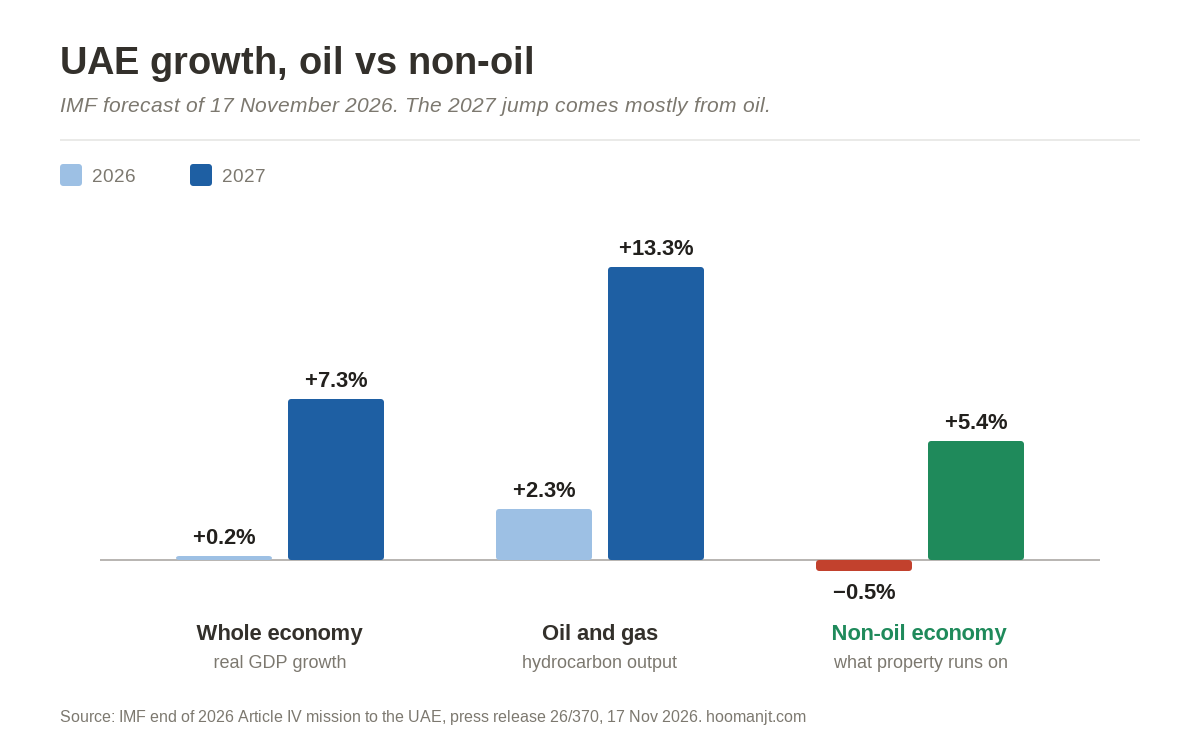
Dubai property runs on the non-oil economy: jobs, new residents, companies and visitors. On the IMF's numbers, non-oil output ends 2027 about 4.9% above 2025. It grew 6.8% in 2025, according to the Central Bank. Even at 5% a year it would have been about 10% bigger after two years. So roughly 5% of the pre-conflict path is gone, and the IMF itself says output in the affected oil exporters stays below its pre-conflict path even after the 2027 rebound.
How to read the double-digit 2027 rebound
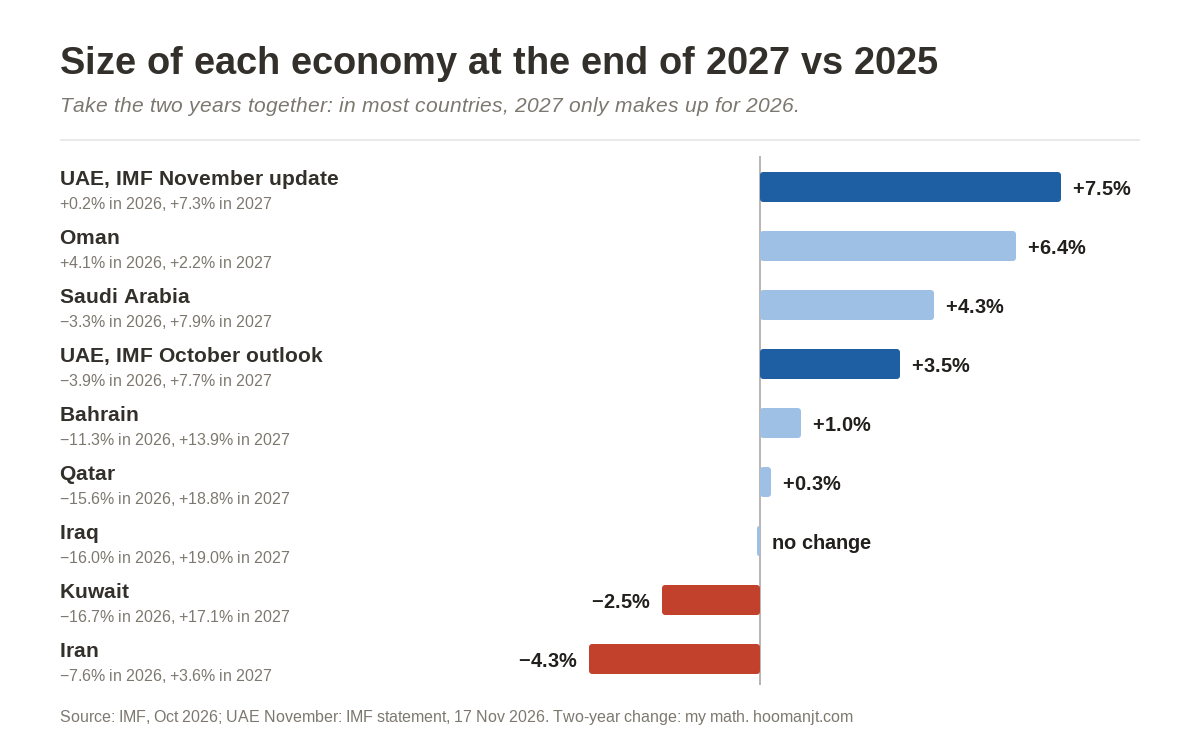
Kuwait at 17.1% and Iraq at 19.0% look spectacular for 2027. Mostly they refill the 2026 hole. Multiply the two years together and Kuwait ends 2027 about 2.5% smaller than in 2025. Qatar is back to roughly its 2025 size, and Iraq is flat. The UAE ends 2027 3.5% bigger on the October numbers, and about 7.5% bigger on November's.
Dubai's economy in the first half of 2026
The Dubai Data and Statistics Establishment reported on 19 October that Dubai's real GDP was about Dh473 billion in the first half of 2026, 2.3% lower than a year earlier. The first quarter grew 2.4%, so the whole fall came in the second. At current prices output was Dh505 billion, up 0.2%.
| Sector | Share of Dubai's economy | Real change, H1 2026 |
|---|---|---|
| Wholesale and retail trade | 20.5% | -6.0% |
| Finance and insurance | 14.0% | 8.8% |
| Real estate | 11.8% | -2.5% (current prices: 5.4%) |
| Transport and storage | 10.7% | -7.4% |
| Construction | - | 2.4% |
The real estate row is the one I read twice. At current prices it grew 5.4%. In real terms it shrank 2.5%. Prices held up while the volume of activity fell. The Dubai Land Department data says the same thing. Monthly deals went from about 20,000 in October 2025 to about 10,000 in May 2026. October 2026 brought 11,937, the first monthly rise since June, still about 40% below a year earlier. The detail is in my October 2026 market report. The IMF's November statement says UAE real estate activity has moderated from earlier peaks, with conditions varying by emirate and segment.
What I take from this as a property buyer
First, do not buy or sell on the headline GDP number. For 2026 and 2027 it is mostly an oil story. I track non-oil growth and the monthly Dubai Land Department deal count instead.
Second, forecasts are moving fast. The IMF's 2026 UAE number went from 3.1% to minus 3.9% and back to 0.2% in seven months. The direction since the summer has been up, which matches the deal data: the low point was May.
Third, the IMF is not describing a banking or housing crisis. It describes a property market that has come off its peak and asks regulators to watch real estate and construction lending. UAE inflation runs at about 5% this year and 3% next. What that does to cash and to off-plan instalments is in my Dubai inflation article.
My read: today's Dubai is a slower market with more room to negotiate, on top of an economy the IMF expects to grow 5.4% outside oil next year. If your horizon is several years, that favours the buyer. If you are putting in money you may need within two years, know that the whole forecast rests on one assumption, that the regional disruption lifts. The IMF names a longer conflict as the biggest risk.
Sources
- IMF World Economic Outlook, 13 October 2026, and the Regional Economic Outlook for the Middle East and Central Asia, 22 October 2026.
- Jihad Azour, Director of the IMF Middle East and Central Asia Department, press briefing remarks, 15 October 2026.
- IMF end of 2026 Article IV mission to the UAE, 17 November 2026.
- Statista, IMF forecasts for selected Middle Eastern countries, 15 April 2026 (April WEO data).
- UAE Central Bank Quarterly Economic Review, as reported by Khaleej Times, 1 October 2026.
- World Bank economic update for the Middle East, North Africa, Afghanistan and Pakistan, 6 October 2026.
- Dubai Data and Statistics Establishment, H1 2026 GDP, via WAM, 19 October 2026.
- The two-year size changes are my arithmetic: the two annual growth rates multiplied together.
Frequently asked questions
In its October 2026 regional outlook, the IMF expects the Middle East, North Africa, Afghanistan and Pakistan to contract 1.3% in 2026 after growing 3.3% in 2025, then grow 6.6% in 2027. The six GCC economies shrink 4.8% on average in 2026 and grow 9.1% in 2027.
0.2% in 2026 and 7.3% in 2027, from the IMF's Article IV mission statement of 17 November 2026. In the October World Economic Outlook the figures were minus 3.9% and 7.7%, and in April they were 3.1% and 5.3%.
Its mission found that oil production recovered after the second quarter disruption and that trade, aviation and tourism indicators point to a gradual recovery. It also credits the government's quick policy response, large fiscal and external buffers and well-capitalised banks. The upgrade was 4.1 points in five weeks.
On the IMF's October numbers: Kuwait minus 16.7%, Iraq minus 16.0%, Qatar minus 15.6%, Bahrain minus 11.3% and Iran minus 7.6%. All of them export almost entirely through the Strait of Hormuz or were directly caught in the conflict.
Oman, at 4.1% on the IMF's October forecast, because its coast lies outside the Strait of Hormuz. The UAE joined it at 0.2% after the IMF's November update.
The IMF projects non-oil growth of minus 0.5% in 2026 and 5.4% in 2027. The UAE Central Bank's latest quarterly review has 1.3% and 4.9%. Non-oil activity grew 6.8% in 2025.
Mostly because oil output returns from a low 2026 base. The IMF sees UAE hydrocarbon growth of 13.3% in 2027. Taken over two years, Kuwait still ends 2027 about 2.5% smaller than in 2025 and Qatar is back to roughly its 2025 size.
Real GDP was about Dh473 billion, down 2.3% on a year earlier, after 2.4% growth in the first quarter. Finance grew 8.8% and construction 2.4%. Trade fell 6%, transport 7.4% and real estate 2.5% in real terms, though real estate rose 5.4% at current prices.
That activity has moderated from earlier peaks, that conditions vary across emirates and market segments, and that real estate and construction exposures need continued monitoring. It describes the banks as well capitalised with improving asset quality.
About 5% on average in 2026, easing to about 3% in 2027 and towards 2% over the medium term as supply pressures and base effects unwind. Dubai's own inflation rate was 5.5% in October 2026.
A 7.6% contraction in 2026 after minus 0.9% in 2025, then 3.6% growth in 2027, which leaves the economy about 4.3% smaller than in 2025. Inflation is projected at 78.6% in 2026 and 42% in 2027.
A longer conflict. The IMF's numbers assume the regional disruption lifts. Further damage to energy production, shipping routes or infrastructure would weaken the Persian Gulf oil exporters again and push inflation up.