
The short version
- Dubai inflation was 5.5 percent in October 2026, up from 5.0 percent in September.
- Petrol drove it, then food. Rent did not. Transport added more to inflation than housing for the first time since October 2022.
- Rent growth is slowing in the official index, and rents on apartment leases registered in October were 5.8 percent below last year.
- A bank deposit pays about 4 to 4.4 percent. A typical apartment nets about 5 percent in rent. Neither covers 5.5 percent inflation on its own.
- If you buy off-plan at a fixed price on a long payment plan, inflation shrinks the real cost of the instalments you pay later. That only helps if the developer delivers, so check the track record and the escrow account.
Stop here and you have the useful part. The rest is the detail behind each line.
Dubai inflation rate in October 2026, in numbers
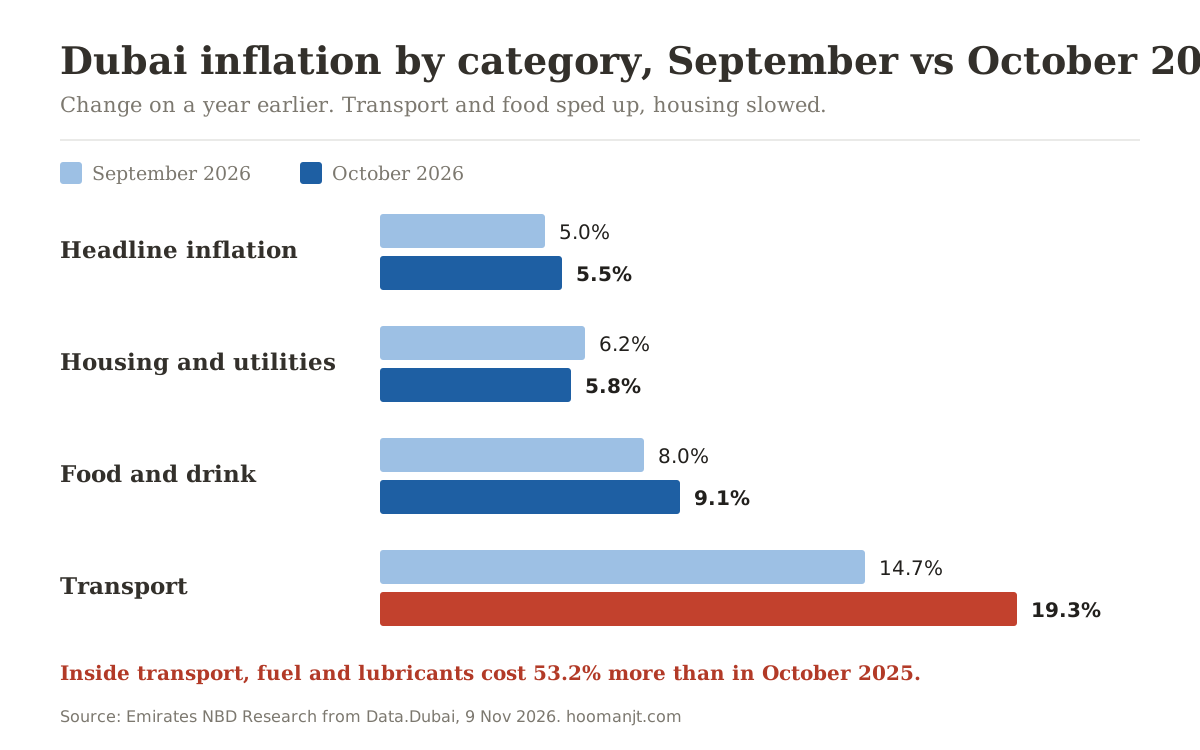
Consumer prices in Dubai, the CPI, were 5.5 percent higher in October than a year earlier. Emirates NBD Research published the breakdown on 9 November from the emirate's official data. September was 5.0 percent and August was 5.5 percent, so the September dip lasted one month. Prices rose 1.1 percent in October alone, after slipping 0.05 percent in September.
| Category | September 2026 | October 2026 |
|---|---|---|
| Headline inflation | 5.0% | 5.5% |
| Housing and utilities | 6.2% | 5.8% |
| Food and drink | 8.0% | 9.1% |
| Transport | 14.7% | 19.3% |
Every figure is the change on the same month a year earlier. Two lines sped up and one slowed. That change in the mix is the real news this month.
Why fuel overtook rent
For most of the last few years, Dubai inflation was a rent story. When I wrote about the September rate rise, housing accounted for roughly 3 of June's 4.8 points. In October, transport added 2.3 points of the 5.5 and housing added 2.2. Housing last came in below transport in October 2022.
The reason is the pump. Transport costs rose 19.3 percent in a year and 6.3 percent in October alone. Fuel and lubricants rose 53.2 percent, the largest annual increase of any item in the basket. Super 98 cost Dh4.40 a litre in October, 58.8 percent more than a year earlier. It came down to Dh4.16 in November, still about 58 percent above November 2025, so the next transport reading will stay high. The month-by-month path is in UAE petrol prices.
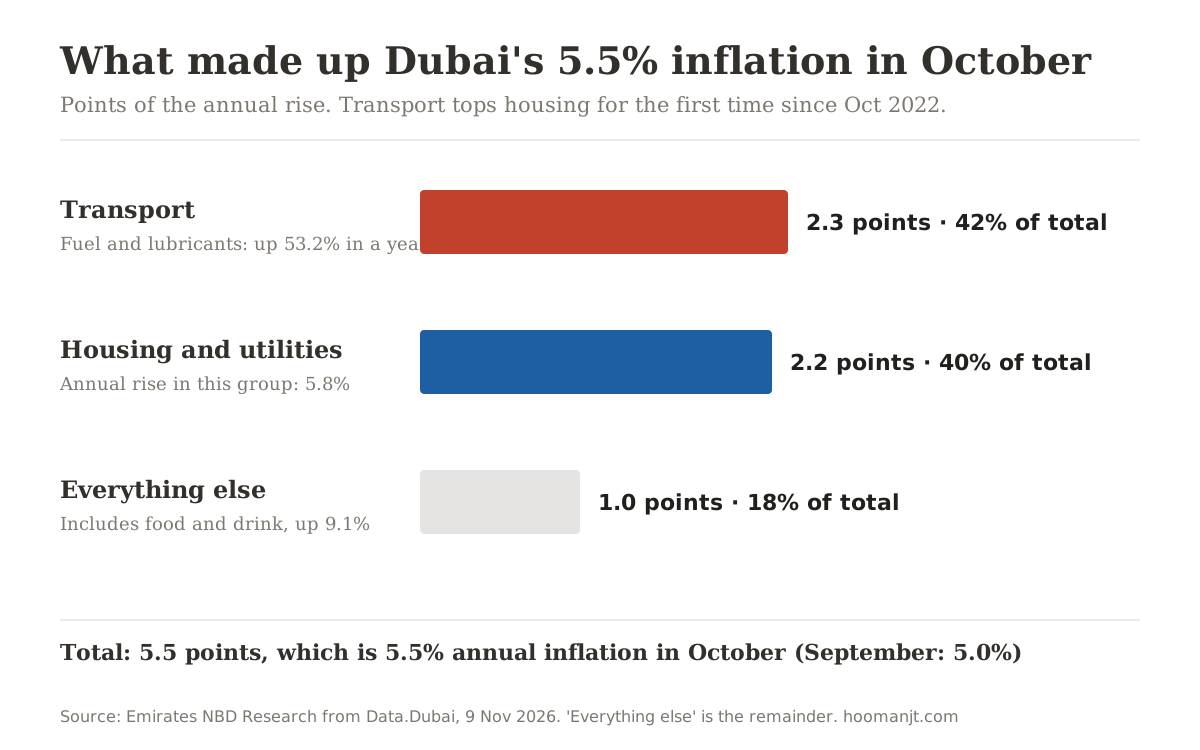
Here is why I think the mix matters more than the headline. Inflation driven by rent tells you more people want homes in Dubai than the city has. Inflation driven by fuel and food is mostly imported. It follows world oil prices and import costs, not demand for apartments in Dubai.
So October's 5.5 percent is not a sign that Dubai housing is overheating. Housing is the part that is cooling.
Dubai rents: the index says up, new leases say down
Housing and utilities is the biggest group in the Dubai basket, about 41 percent of it. Its annual rise slowed from 7.4 percent at the start of the year to 6.2 percent in September and 5.8 percent in October.
Now set that next to the October market report. The median annual rent on apartment leases registered with the Dubai Land Department in October was Dh67,800. That is 5.8 percent lower than in October 2025. Same month, same 5.8, opposite sign.
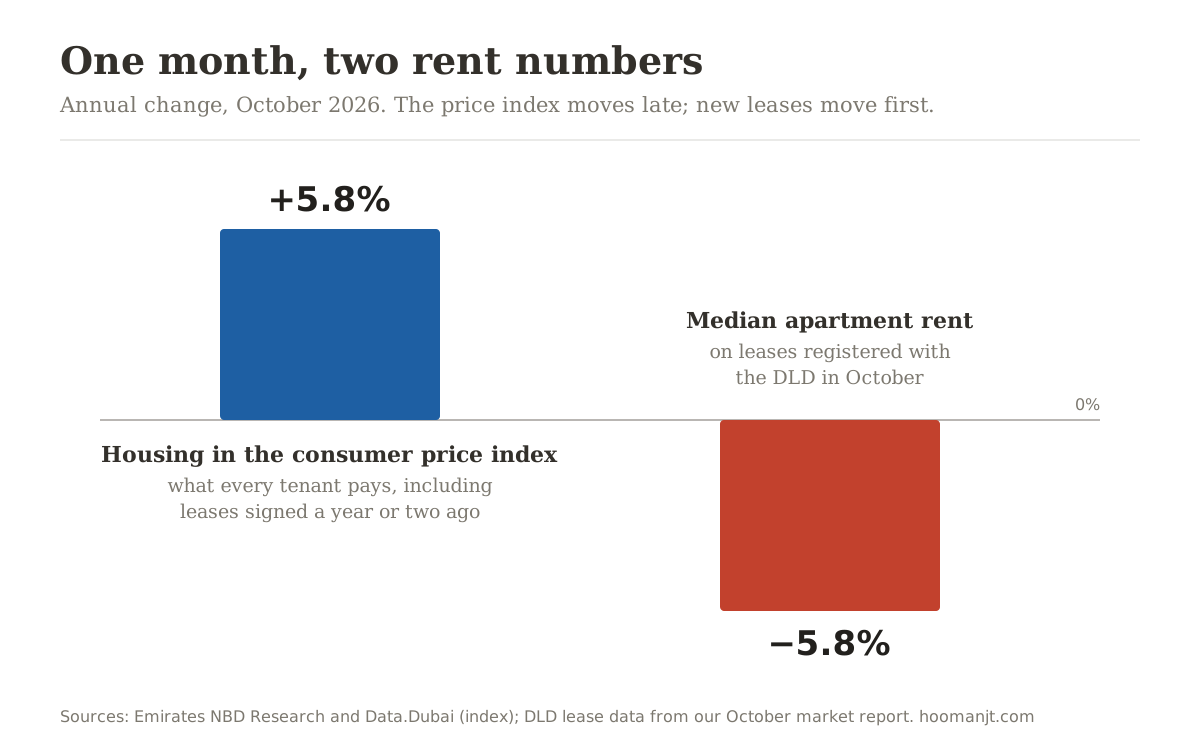
Both numbers are right. They measure different things. The price index measures what every tenant in Dubai pays this month, including leases agreed a year ago. Most leases reprice once a year, and the renewal increase is capped by the RERA rental index, so the index moves slowly. The median on leases registered this month shows the rent being agreed now, new and renewed.
What I take from it: housing inflation in the index has further to fall. Every month, cheaper leases agreed today replace dearer ones from last year. Emirates NBD reaches the same place from the other side. Housing is the largest part of the basket, and as it moderates it holds headline inflation down.
Dubai food prices: the fastest rise since 2010
Food and drink cost 9.1 percent more than a year earlier. That was 8.0 percent in September and 0.9 percent in January. Emirates NBD says it is the fastest rise since at least January 2010. Monthly growth only eased from 1.1 to 1.0 percent, so the pressure has not broken.
This matters for rents more than it looks. In July I wrote that recruiters had cut the 2026 UAE salary forecast from 2.5 to 3 percent growth to roughly zero. If your pay did not move this year, 5.5 percent inflation takes about 5 percent off what it buys. A household paying more at the pump and the supermarket has less room for a higher rent. That is one more reason I do not expect rents to start climbing fast again soon.
Hotels and holiday homes
The biggest monthly jump in the whole basket was accommodation: hotel and similar stays rose 66.1 percent from September to October. They are still 11.7 percent below October 2025. Part of it is the season, which starts in October. Part of it is hotels regaining pricing power after steep falls earlier this year.
If you run a holiday home, do not annualise one good month. Compare it with the same month last year. That comparison is still negative.
Cash in the bank vs property: the real return
The Central Bank of the UAE has held its Base Rate at 3.90 percent since 17 September, and kept it there after the Federal Reserve held on 28 October. The dirham is pegged, so the UAE rate is set in Washington, not by Dubai's inflation.
A dirham deposit at a mainstream bank pays about 4 to 4.4 percent. The retail government sukuk paid a fixed 4.30 percent. At 5.5 percent inflation, money left in the bank loses roughly 1 to 1.5 percent of its buying power a year.
Rent alone does not clear the bar either. In September I put the net yield on a typical Dubai apartment at about 5 percent, after service charges, upkeep, management and a few weeks of vacancy. For a villa it was about 3 percent.
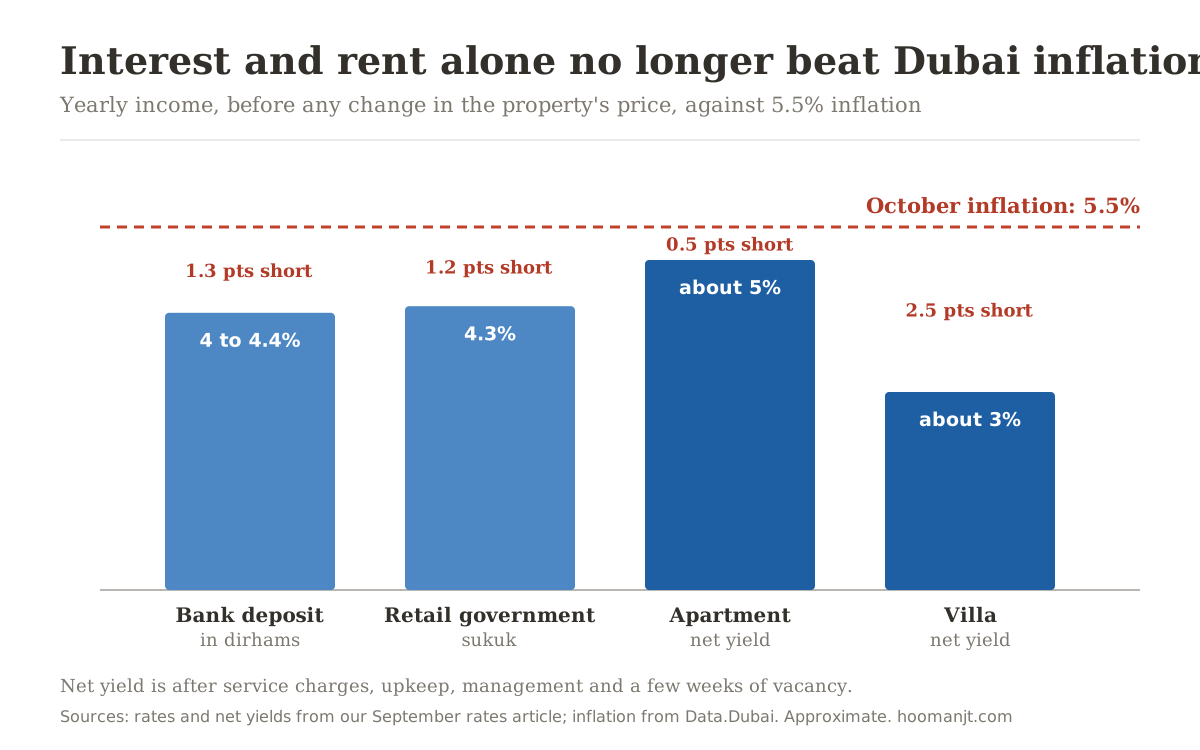
Property has one advantage over a deposit. It is a real asset, and its price can rise with inflation. That does not happen automatically. Over the last twelve months, resale apartment prices fell 2.1 percent and rents fell 5.8 percent. Put an average apartment's roughly 5 percent net rent next to that price change, and its return for the year was about 3 percent. Below inflation.
So inflation does not turn every property into a hedge. It makes the choice of property matter more. What holds its value is stock that is scarce, rents to a real tenant base, and was bought at the right price. I separate the two sources of return in yield versus appreciation.
Mortgages: debt gets cheaper in real terms, for now
With mortgage rates around 4 percent and inflation at 5.5 percent, the real interest rate is negative. In plain terms, a fixed-rate loan shrinks in real value every year. Today's instalment becomes a smaller share of your income later, as long as your income keeps up with prices.
Two caveats. Emirates NBD expects inflation to ease in 2027 as oil prices moderate, so a negative real rate is probably temporary. Do not build a purchase on it. And banks still cap total repayments at about half of monthly income. Inflation does not change that cap. Run your own figures in the mortgage calculator.
Off-plan: where inflation works for the buyer
An off-plan purchase fixes today's price and moves part of the payment into the future. When inflation is high, that suits the buyer, because the later instalments are paid in dirhams that buy less.
A simple example. You buy a Dh2 million unit on a 60/40 plan, and Dh800,000 is due at handover in three years.
| Inflation until handover | Dh800,000 in today's money | Real cost saved |
|---|---|---|
| 3% a year | about Dh732,000 | about 8.5% |
| 5.5% a year | about Dh681,000 | about 15% |
The saving is real only if the developer hands over on time and the unit holds its value. A fixed price works in both directions. If the market falls, you still owe the full amount.
Construction costs point the same way. In October's Dubai PMI survey, firms raised selling prices at the fastest pace in the survey's history, and construction was one of the sectors named. Developers usually pass that into the next launch. But as I showed in construction costs and Dubai property prices, a 10 percent rise in building costs justifies about 3 percent on price at a large integrated developer and about 6 percent at a small one. Not 10. When you hear that prices must rise as much as costs, keep that arithmetic in mind.
The squeeze lands on the thinnest margins first. Smaller developers have less room, and higher costs raise their risk of delay. In this cycle, the developer's delivery record and the project's escrow account matter more than the discount.
What happens next for Dubai inflation
Emirates NBD expects annual inflation to stay broadly stable in November and December, then ease in 2027 as global oil prices moderate. Oil fell sharply in early November, but the report notes the fall has to hold through the end of the month to lower December's pump prices.
The risk is to the upside. Dubai firms raised selling prices at a record pace in October, across construction, wholesale and retail, and travel and tourism. When demand is firm, costs pass through more easily.
My read: fuel and food keep headline inflation up for the next few months, and housing pulls it down. For property, the number to watch is rent growth, and it is still slowing.
What I would do
- If you rent, check your renewal against the RERA index before you sign. Rents on apartment leases registered in October were below last year, which gives you room to negotiate.
- If you are a landlord, work out the yield on today's rent, not last year's. Keeping a good tenant at a smaller increase usually costs less than a few empty weeks.
- If you hold cash, a deposit loses about 1 to 1.5 percent a year in buying power right now. That is not a reason to rush a purchase, but waiting has a cost too.
- If you are buying off-plan, a fixed price on a long plan is worth more in this cycle. Pick a developer with a delivery record and pay only into the project's escrow account.
- If you need a mortgage, fix the rate where you can, and size the loan so the payments still work if inflation falls back in 2027.
If you want to go through your own numbers, whether that is a purchase, a sale or a building you already own, message me on WhatsApp or call me on the same number.
Sources
- Emirates NBD Research, Dubai inflation rebounds on higher transport and food prices, Daniel Richards, 9 November 2026, from Data.Dubai.
- Khaleej Times, Dubai inflation rises to 5.5% as transport, food prices increase, 16 November 2026.
- Central Bank of the UAE, Base Rate held at 3.90 percent after the Federal Reserve's decision of 28 October 2026.
- Rents and prices: Dubai property market report, October 2026, from Dubai Land Department data.
Frequently asked questions
5.5 percent on a year earlier, up from 5.0 percent in September and back to August's level. Prices rose 1.1 percent in October alone. Emirates NBD Research published the figures on 9 November from Dubai's official data.
Fuel, then food. Transport costs rose 19.3 percent in a year, and fuel and lubricants 53.2 percent. Food and drink rose 9.1 percent. Housing slowed from 6.2 to 5.8 percent and partly offset the rest.
Yes, narrowly. In October transport added 2.3 percentage points to the 5.5 percent and housing 2.2 points. Housing last contributed less than transport in October 2022. In June, housing alone was roughly 3 of 4.8 points.
Slower, and on new agreements they are falling. Housing in the price index rose 5.8 percent a year, down from 7.4 percent in January. The median rent on apartment leases registered in October was Dh67,800, 5.8 percent below October 2025. The index lags because it covers every lease, including those agreed a year ago.
Super 98 is Dh4.16 a litre and Special 95 Dh4.04. Super 98 was Dh4.40 in October, 58.8 percent above a year earlier, and November's price is still about 58 percent above November 2025.
The Central Bank of the UAE Base Rate is 3.90 percent, unchanged since 17 September and held after the Federal Reserve's 28 October decision. The dirham is pegged to the dollar, so the UAE rate follows the US rate, not Dubai's inflation.
No. A dirham deposit at a mainstream UAE bank pays about 4 to 4.4 percent against 5.5 percent inflation, so cash loses roughly 1 to 1.5 percent of its buying power a year at current rates.
Not automatically. Net rental yield is about 5 percent on a typical apartment and about 3 percent on a villa, both below 5.5 percent. Resale apartment prices also fell 2.1 percent over the last twelve months. Property holds its value against inflation when it is scarce, rents to a real tenant base and was bought at the right price.
The price is fixed, so inflation cuts the real cost of later instalments. Dh800,000 due in three years is worth about Dh681,000 in today's money at 5.5 percent inflation, and about Dh732,000 at 3 percent. The saving only counts if the developer delivers on time.
Emirates NBD expects it to stay broadly stable in November and December and to ease in 2027 as oil prices moderate. The risk is upward: in October's PMI survey, Dubai firms raised selling prices at the fastest pace in the survey's history.
Food and drink cost 9.1 percent more in October 2026 than a year earlier, up from 8.0 percent in September and 0.9 percent in January. Emirates NBD calls it the fastest rise since at least January 2010.
The dirham is pegged to the dollar, and on the Tehran open market it went from about 38,400 toman in January 2026 to about 74,200 in November. Against the toman, dirham assets held their value. Once the money is in dirhams, though, the benchmark is Dubai's 5.5 percent, and a property has to earn at least that to keep its buying power.