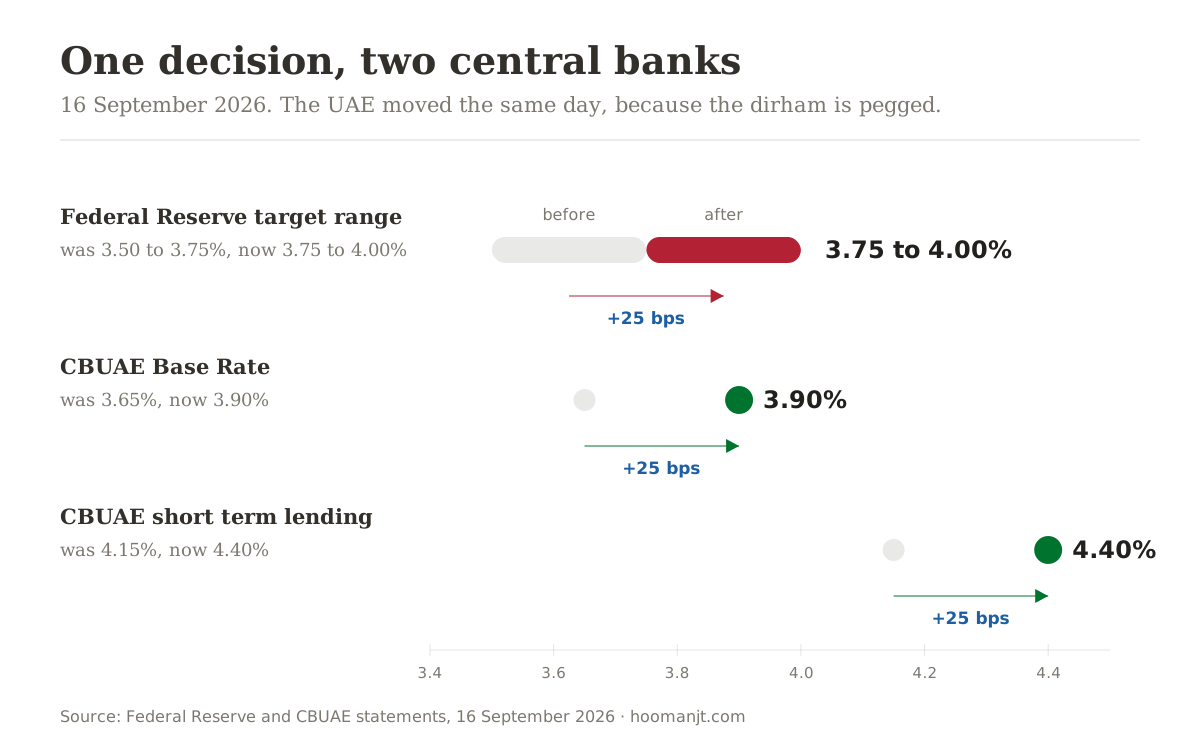
On 16 September the Federal Reserve raised its target range by a quarter point to 3.75 to 4 percent, its first increase since July 2023. Hours later the Central Bank of the UAE moved its own Base Rate from 3.65 to 3.90 percent, effective 17 September. The UAE did not choose this. The dirham is pegged, so the decision arrived here the same day it was made in Washington. What follows is what it actually does to prices, to hiring, and to the numbers on a Dubai property.

The short version
- The UAE Base Rate went from 3.65 to 3.90 percent. The Fed target range is now 3.75 to 4 percent.
- If your mortgage is on a variable rate, your payment goes up. On a Dh1.6M loan that is about Dh222 a month.
- If you hold cash, banks and government paper now pay you roughly 4 to 4.3 percent for taking almost no risk.
- That is the whole story for property. A property has to beat that number after costs, or the money stays in the bank.
- The one thing to check: work out the net yield after service charges, not the gross number in the listing.
Stop here and you have the part that matters. The rest is for anyone who wants the mechanism.
Why the UAE had no choice
The dirham has been fixed at 3.6725 to the US dollar since 1997. A country that fixes its exchange rate gives up control of its own interest rate. If UAE rates drifted away from US rates, money would move to capture the difference and the peg would come under pressure.
So the CBUAE anchors its Base Rate to the rate the Fed pays on reserve balances, and it moves on the same day, every time. The Base Rate applies to the Overnight Deposit Facility and sets the floor for overnight money in the UAE. Short term borrowing from the central bank stays 50 basis points above it, so that is now 4.40 percent.
Here is the part people miss. The UAE imports US monetary policy, but it does not import the US economy. The Fed raised because American inflation stayed high. UAE inflation has a different source and a lower reading. The medicine was mixed for a different patient.
What it does to inflation
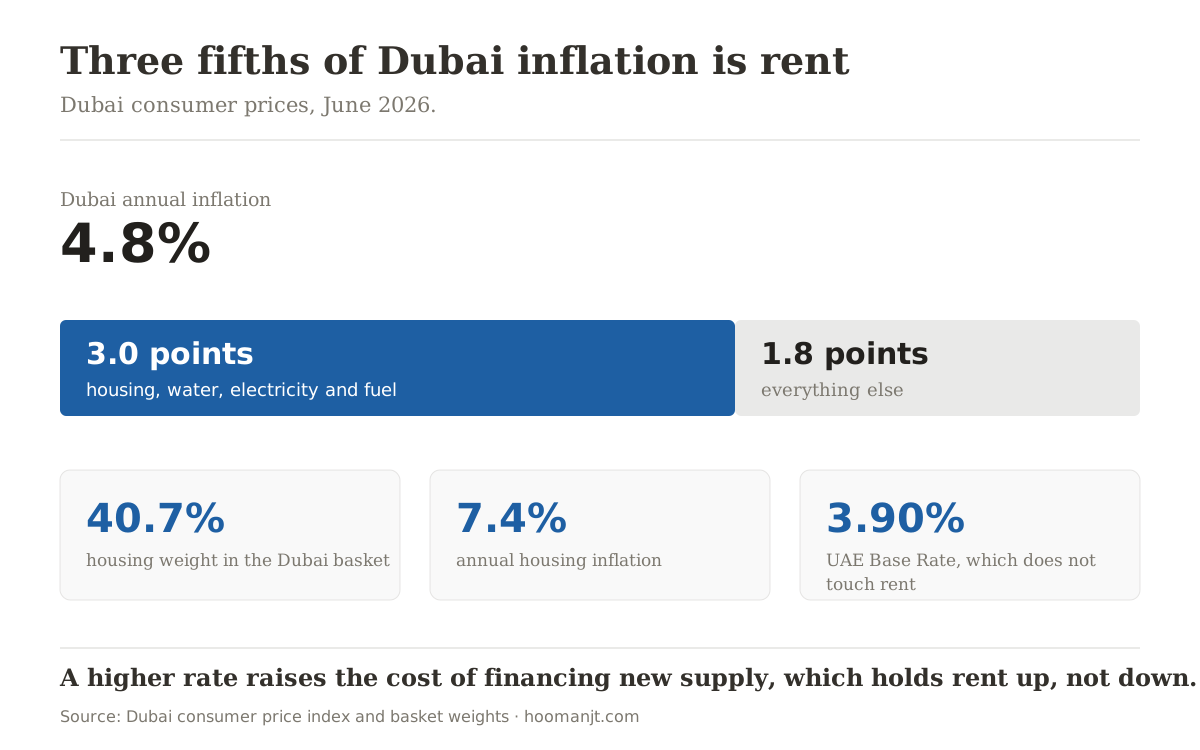
Dubai consumer prices ran at 4.8 percent in June 2026, and housing ran hotter at 7.4 percent. Housing, water, electricity and fuel make up about 40.7 percent of the Dubai basket. Multiply those together and housing alone accounts for roughly 3 of the 4.8 points. Close to three fifths of Dubai inflation is rent.
A rate rise does very little to that. Most Dubai tenants do not hold a mortgage, and a large share of landlords bought in cash, so a higher Base Rate does not push rents down. Where it does bite is on the financing of new buildings. Some projects start later, supply arrives thinner in two or three years, and that keeps rents high rather than low.
There is a genuine disinflationary channel, and it runs through the peg. A higher US rate supports the dollar, the dirham rides with it, and everything the UAE imports gets cheaper in dirham terms. Food, cars and electronics all sit in that column. The August purchasing managers survey already showed input cost inflation at its slowest since February. Put the two together and you get goods cooling while rent stays stubborn.
What it does to jobs
The non oil economy grew 4.8 percent in the first quarter of 2026 and now makes up just over 79 percent of UAE output. The purchasing managers index hit 55.3 in August, the strongest since late 2024, with new orders at their best in more than two years.
Hiring has not kept pace with that, and the reason is the cost of money. When rates rise, the first places to slow down are the ones that run on borrowed capital: construction, project development, small businesses, anything scaling on credit. In Dubai those sectors employ a lot of people.
The other side is real and it is often ignored. A higher rate in a jurisdiction with no personal income tax and a currency fixed to the dollar pulls capital in. Banking, wealth management and family offices benefit from exactly this, and they are still hiring. So the honest read is not that the labour market weakens. It changes shape, and salary growth slows most in the parts of the economy that run on debt.
What the quarter point costs a borrower
Take a Dh2M property, 20 percent down, a Dh1.6M loan over 25 years.
| Mortgage rate | Monthly payment | Difference |
|---|---|---|
| 3.99 percent | Dh8,437 | Base case |
| 4.24 percent | Dh8,659 | Dh222 more |
Dh222 a month is not dramatic. It is about Dh2,660 a year and roughly Dh66,000 across the life of the loan. The larger effect is on what you can borrow at all. Banks cap total repayments at around half of monthly income, so the same salary now supports a loan about Dh61,000 smaller. Your buying power fell without your income changing.
If you are on a fixed rate, nothing changes until it expires. The repricing is where it lands. Run your own figures in the mortgage calculator.
Property now has to beat a near risk free 4 percent
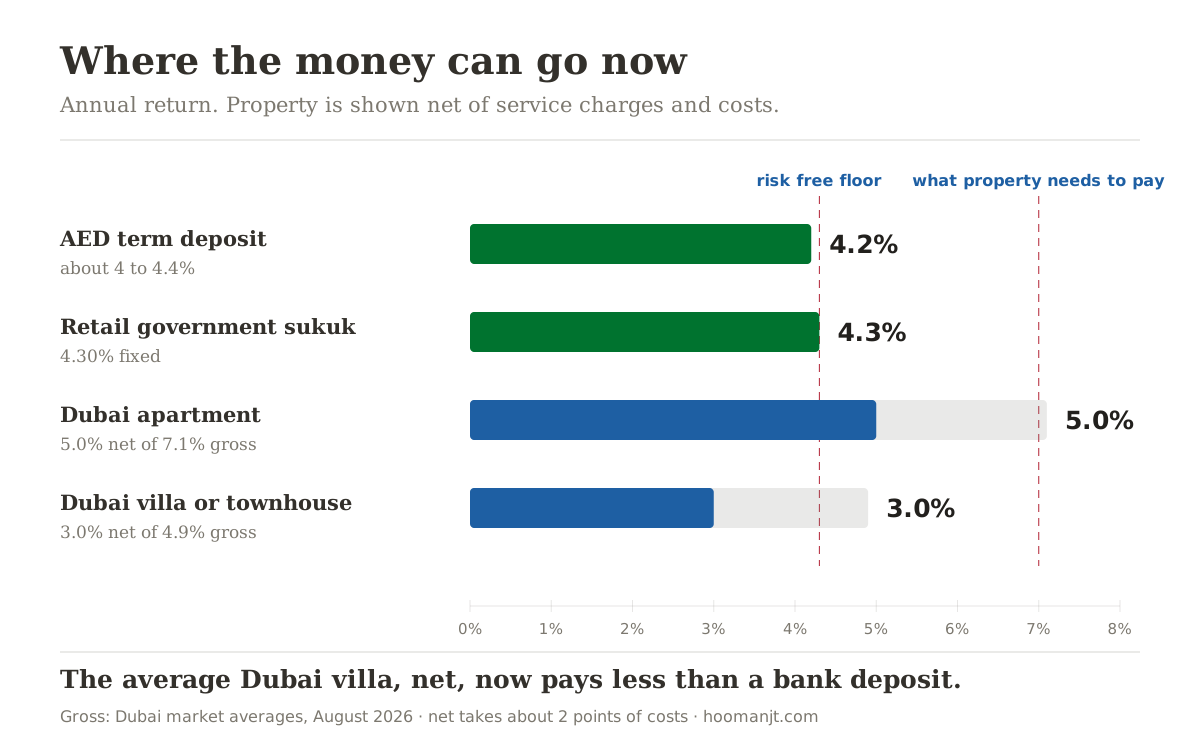
This is the part that matters most, and it is the part the market talks about least. An investor always has an alternative, and the alternative just got better. A dirham term deposit at a mainstream UAE bank pays roughly 4 to 4.4 percent. The UAE retail government sukuk paid a fixed 4.30 percent for two years with the government behind it.
Now put a property next to that.
| Where the money sits | Annual return | Risk and liquidity |
|---|---|---|
| AED term deposit | About 4 to 4.4 percent | Very low risk, money accessible |
| Retail government sukuk | 4.30 percent fixed | Government backed |
| Dubai apartment | About 7.1 percent gross, about 5 percent net | Vacancy and tenant risk |
| Dubai villa or townhouse | About 4.9 percent gross, about 3 percent net | Slow to sell, high upkeep |
Read the villa line twice. A gross yield of 4.9 percent looks fine in a listing. After service charges, maintenance, management and a few weeks of vacancy, about 3 percent survives. That is below a bank deposit, on an asset you cannot sell in a week.
Apartments do better and land near 5 percent net, but that is only about 70 basis points over the sukuk. For something that takes months to exit and costs 6 to 7 percent to enter, 70 basis points is not a premium. It is a rounding error.
What still clears the hurdle
The answer is not that property stopped working. It is that average property stopped working. When the risk free rate is 4.3 percent, an illiquid asset has to pay several points more to justify itself. Either net yield gets to 7 percent and above, or the return has to come from somewhere other than rent.
Three things still clear that bar.
- Stock that is genuinely scarce and cannot easily be rebuilt. Direct beach access, a specific floor and view in a tower that is finished, a plot type a community will never issue again.
- Off plan bought on a long payment plan, because you are not paying the full price on day one. The return is measured against the money you have actually put in, not against the headline price.
- Locations still forming, where the return comes from capital growth rather than rent. I separate those two in yield versus appreciation.
Guaranteed ROI will get more popular, so read the contract
When a buyer is comparing against a bank rate, a product that quotes its own fixed number is easier to sell. I expect guaranteed ROI offers to become much more visible over the coming months. They are not automatically bad. Before you sign one, get five things in writing.
- Who is guaranteeing it. A developer guarantee is worth exactly what that developer's balance sheet is worth. It is not a bank guarantee.
- How many years it runs, and what the real rent is the day after it ends. A guaranteed three years on a unit that then rents for half the number is not a return, it is a deferred problem.
- Whether the purchase price was set above market to fund the guarantee. Sometimes you are being paid your own money back.
- Whether service charges come out of the guaranteed figure or sit on top of it.
- Whether it is registered with the DLD or sits in a side agreement with the developer.
What I would check before buying in this cycle
- Work out net yield yourself. The net yield calculator gives you the number after service charges instead of the one in the advert.
- Ask for the service charge per square foot. The spread from Dh10 to Dh25 moves your return by one to two full points.
- Put entry costs in the model: 4 percent DLD, about 2 percent agency, trustee office fees, and 0.25 percent of the loan if you are financing.
- Do not plan a hold shorter than three years. At 6 to 7 percent to get in, a quick flip does not survive these rates.
- Look at what is under construction in the same community. Heavy handover in two years is pressure on your rent.
The market got more selective, so the choosing matters more
When the risk free rate was low, most purchases worked out and general market growth covered a weak choice. That cover is thinner now. The gap between two units in the same tower, or two projects in the same community, now shows up directly in what you earn. The margin for error narrowed, which means the analysis behind the decision is itself part of the return.
About me
I am Houman Jalouti, a civil engineering graduate with an MBA in marketing and finance. What I do is work out whether a specific property is the right investment for you, using the kind of numbers you just read rather than a promise. If you have a property in mind, or you want to know where you stand in this cycle, get in touch on whichever channel suits you: WhatsApp, phone, email or the contact form. The first review costs you nothing.
#DubaiRealEstate #UAEInterestRates #FedRateHike #CBUAE #DubaiProperty #PropertyInvestment #HoumanJalouti
Frequently asked questions
It raised the target range for the federal funds rate by 25 basis points to 3.75 to 4 percent. The vote was 12 to 0 and it is the first increase since July 2023. The statement pointed to inflation staying elevated, and the updated projections leave the door open to one more increase this year.
The CBUAE base rate on the Overnight Deposit Facility went from 3.65 to 3.90 percent, effective 17 September 2026. Borrowing short term liquidity from the central bank stays 50 basis points above the base rate, so that is now 4.40 percent.
The dirham has been fixed at 3.6725 to the US dollar since 1997. A country that fixes its exchange rate cannot set its own interest rate, because any gap between local and US rates moves money and puts the peg under pressure. So the CBUAE anchors its base rate to the Fed and moves on the same day.
On a Dh1.6M loan over 25 years, a move from 3.99 to 4.24 percent takes the monthly payment from Dh8,437 to Dh8,659. That is Dh222 a month, about Dh2,660 a year, and roughly Dh66,000 across the life of the loan. If you are on a fixed rate, nothing changes until it reprices.
Yes. UAE banks cap total repayments at around half of monthly income. At a Dh12,500 monthly repayment ceiling, the same salary supported about Dh2.37M at 3.99 percent and about Dh2.31M at 4.24 percent. That is roughly Dh61,000 less, or 2.6 percent of buying power, with no change to your income.
Not directly. Most Dubai tenants do not hold a mortgage and a large share of landlords bought in cash, so the base rate does not reach rent. Where it does reach is the financing of new buildings, which can thin supply in two to three years and hold rents up rather than down.
Dubai consumer prices ran at 4.8 percent in June 2026, with housing at 7.4 percent. Housing, water, electricity and fuel are about 40.7 percent of the Dubai basket, so housing alone accounts for roughly 3 of those 4.8 points, close to three fifths of the total.
It changes the mix more than the level. The non oil economy grew 4.8 percent in the first quarter of 2026 and the purchasing managers index hit 55.3 in August, the strongest since late 2024, yet hiring stayed cautious. Debt funded sectors such as construction, development and small business slow first, while banking and wealth management keep hiring because higher rates in a no income tax jurisdiction pull capital in.
A dirham term deposit at a mainstream UAE bank pays roughly 4 to 4.4 percent depending on tenor and minimum balance, and the UAE retail government sukuk paid a fixed 4.30 percent for two years. Promotional accounts advertise more, usually with tiers or conditions attached. That band is the number a property has to beat.
It depends entirely on the specific asset. A Dubai apartment averages about 7.1 percent gross and lands near 5 percent net, which is only about 70 basis points over the sukuk. A villa averages 4.9 percent gross and about 3 percent net, which is below a bank deposit. Average stock no longer clears the bar. Scarce stock, a long payment plan, or genuine capital growth still can.
With a risk free rate around 4.3 percent, an illiquid asset needs several points more to justify itself. I work to about 7 percent net and above on rent alone, or the return has to come from capital growth or from paying in instalments rather than up front. Entry costs of 6 to 7 percent are part of that calculation.
They are not automatically bad, and they will get more common because they quote a number a buyer can compare to a bank rate. Check five things: who is guaranteeing it and what their balance sheet looks like, how many years it runs and what the real rent is afterwards, whether the purchase price was set above market to fund it, whether service charges come out of the guaranteed figure, and whether it is registered with the DLD or sits in a side agreement.
At least three years. Entry costs run about 6 to 7 percent once you add the 4 percent DLD transfer fee, roughly 2 percent agency, trustee office fees and 0.25 percent of the loan on a mortgage. At these rates a short flip does not recover that, so the holding period has to be long enough to amortise the cost of getting in.