Imtiaz has launched The Archive in Dubailand Residence Complex, the district listings shorten to DLRC, and the idea behind it is simple enough to explain in one line: you come home through a library, not a lobby. Two storeys of shelves, a spiral stair, ten thousand books meant to be read.
That is the part everyone will repeat. It is not the part that decides whether you should buy. Below are the actual numbers from the developer's own brochure, what they work out to per square foot against the rest of the Dubai market, who I think rents this building, and what I would check before signing.

The Archive by Imtiaz at a glance
- Developer: Imtiaz Developments. Project: The Archive, launched August 2026.
- Location: Dubailand Residence Complex, written DLRC on most listings, off Sheikh Zayed Bin Hamdan Al Nahyan Road, with Al Ain Road and Emirates Road close by. Toll free, no Salik on the route.
- Building: basement, ground, three podium levels, thirteen residential floors and a roof.
- Unit mix: studios, one bedroom in two layouts, two bedroom and three bedroom. Sizes run from 384 to 1,884 sqft including balconies.
- Prices from Dh666,000 for a studio, Dh979,000 for a one bedroom, Dh1.55M for a two bedroom and Dh1.9M for a three bedroom.
- Two payment plans, both starting at 20 percent plus the 4 percent DLD fee and an admin fee on booking.
- Handover: Q3 2028. Tenure: freehold, open to all nationalities. Escrow: DLD registered.
- Units are delivered fully furnished. Stand shower, no bathtub, and accessories are not included.
- Eighteen amenities, four of which are reading spaces.
The library is the product, not a lobby feature
The reception desk is built from stacked books. Behind it a wall of lit drawers runs to the ceiling. The library itself is two storeys wrapped by a spiral stair, and off it sits a Writer's Room: one desk, a door that actually closes, nothing else. There is a Reading Lounge next to the library and a Reading Salon on the roof with a fireplace, a firepit and a water feature.
The rest of the amenity list is more conventional and none the worse for it: a gym under a gold and glass lattice, adult and kids rooftop pools, floating cabanas over a shallow water feature, a rooftop terrace garden, an outdoor cinema, a barbecue lounge, mini golf, a kids' play area and a pets' area.

I will be straight about what a theme like this does and does not do. It will not, by itself, add a dirham to your resale price in 2028. What it does do is give the building an identity that is easy to remember and easy to market, in a submarket where most towers are hard to tell apart in a listing photo. For a landlord competing for a tenant, that is worth something real. Treat it as a letting advantage, not a valuation one.
The Archive price list, unit by unit
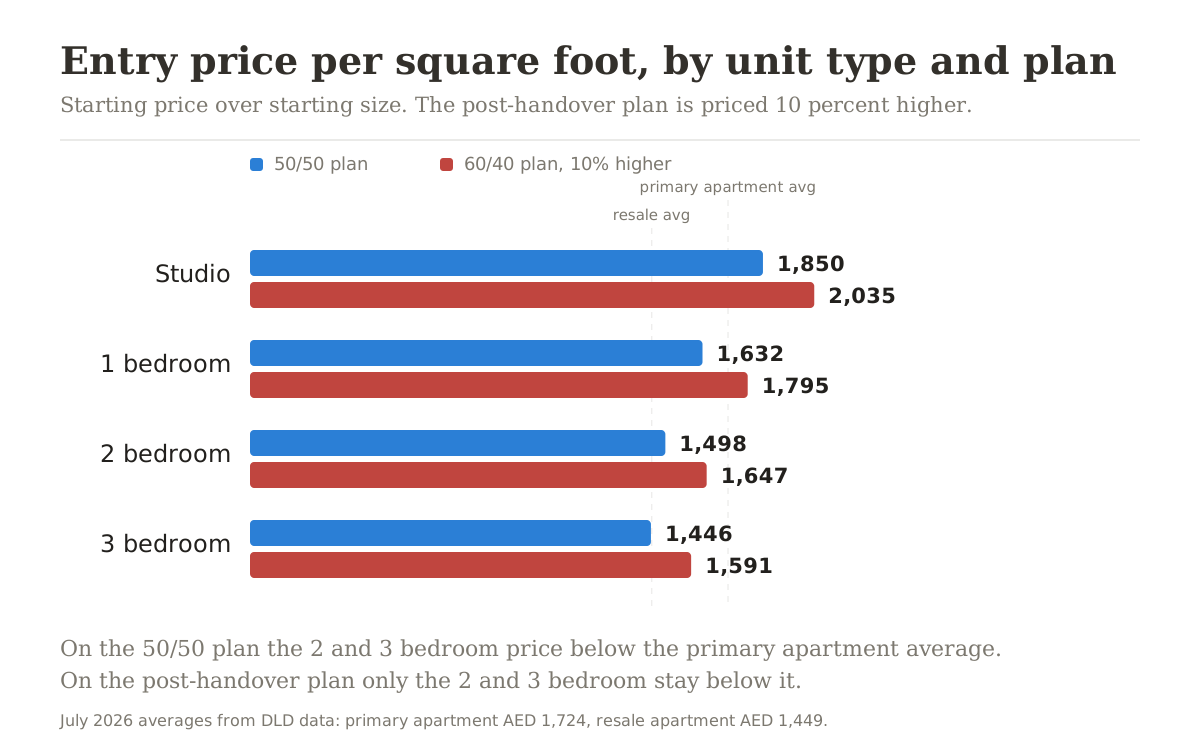
This is the number that decides the investment, so here it is properly. One thing has to be said first, because it changes everything below: the post-handover plan is priced 10 percent higher than the standard plan. Every figure in this section is the standard 50/50 price, and the second column of the chart is what the same unit costs per foot if you take the tail.
| Unit | 50/50 price | From (sqft) | Per sqft, 50/50 | Per sqft, 60/40 |
|---|---|---|---|---|
| Studio | Dh666,000 | 360 | about Dh1,850 | about Dh2,035 |
| 1 bedroom | Dh979,000 | 600 | about Dh1,632 | about Dh1,795 |
| 2 bedroom | Dh1,550,000 | 1,035 | about Dh1,498 | about Dh1,647 |
| 3 bedroom | Dh1,900,000 | 1,314 | about Dh1,446 | about Dh1,591 |
Now put that against the market. In July 2026, primary apartments across Dubai priced at an average of Dh1,724 per square foot and resale apartments at Dh1,449.
On the standard plan the two bedroom and the three bedroom come in below the citywide primary apartment average, and the three bedroom lands almost exactly on the resale average, which is to say you are paying second hand money for a new build with a 2028 handover. The one bedroom sits comfortably under the primary average. The studio, at roughly Dh1,850, prices above it.
Add the 10 percent and the picture tightens. On the post-handover plan the one bedroom moves from Dh1,632 to Dh1,795, which puts it above the primary apartment average rather than below it, and the studio goes to roughly Dh2,035. Only the two and three bedroom stay under the market. That is the honest way to read the tail: it is a financing product with a price attached, not a free extra.
The size pattern is worth understanding rather than just noting. Small units always carry the highest price per foot, because the fixed cost of a kitchen and a bathroom spreads over fewer feet and because entry tickets sell fastest at launch. If you are buying the story, the studio is the cheapest way in. If you are buying value per foot, the two and three bedroom are the better instruments on either plan. One footnote for anyone who needs it: on the post-handover plan a three bedroom starts at Dh2.09M, which clears the Dh2M golden visa threshold at the entry size, where the standard plan at Dh1.9M does not.
Floor plans and unit sizes
Prices only mean something once you know what you are getting for them, so here are the sizes those figures buy.
| Unit type | Size from (sqft) | Price from, 50/50 |
|---|---|---|
| Studio | 360 | Dh666,000 |
| 1 bedroom | 600 | Dh979,000 |
| 2 bedroom | 1,035 | Dh1,550,000 |
| 3 bedroom | 1,314 | Dh1,900,000 |
Across the whole building sizes run from 384 to 1,884 sqft including balconies, so the largest unit is nearly five times the smallest. The one bedroom is published in two layouts. The rest of the range sits between those entry sizes and that 1,884 sqft ceiling, which means the three bedroom line in particular covers a lot of ground and the price per foot inside it moves more than in any other type.
There is a discrepancy in the developer's own document worth pinning before you use any per foot number, including mine. The brochure's facts page prints a studio starting size of 360 sqft. Its typologies table prints a 384 sqft minimum. Seven percent of a studio is not a rounding error: at Dh666,000 it moves the price per foot from about Dh1,850 to about Dh1,734.
Individual floor plans are released per unit rather than published as a set. If you want the plate for a specific unit number, ask me for it and I will send the drawing with the current price against it.
The two payment plans compared
Both plans open the same way in structure: 20 percent plus the 4 percent DLD fee plus an admin fee on booking. They do not open the same way in cash, because the post-handover plan carries a 10 percent higher price.
On the standard plan a studio is Dh133,200 plus Dh26,640 of DLD fee, so under Dh160,000 gets you in before the admin fee. On the post-handover plan the same studio is priced at Dh732,600, so booking is Dh146,520 plus Dh29,304, closer to Dh176,000. For a one bedroom it is Dh195,800 plus Dh39,160 on the standard plan, against Dh215,380 plus Dh43,076 on the tail.
| Instalment | 50/50 plan | 60/40 plan |
|---|---|---|
| Price | list price | list price plus 10% |
| On booking | 20% | 20% |
| 15 Nov 2026 | 5% | 5% |
| 1 Apr 2027 | 5% | 10% |
| 15 Aug 2027 | 5% | 5% |
| 1 Nov 2027 | 5% | 10% |
| 15 Feb 2028 | 5% | 5% |
| 1 Jul 2028 | 5% | 5% |
| Q3 2028 | 50% on completion | |
| Post handover | 40% over 3 years, 3.3% per quarter |
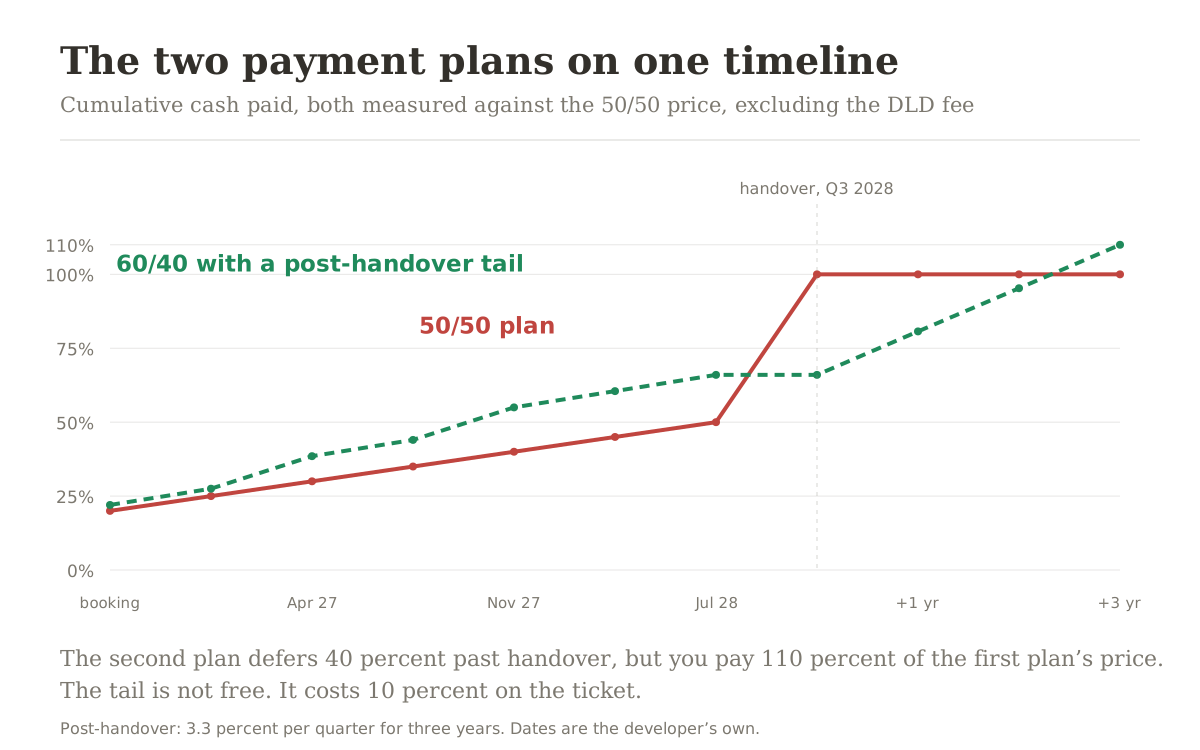
Read the percentages as shares of each plan's own price, which is why the chart above restates both against the same base. Measured that way, the standard plan finishes at 100 and the post-handover plan finishes at 110.
The second plan is the more interesting one, and being precise about it matters more now that the premium is on the table. Forty percent of the price falls after you already hold the keys, so the unit can be earning rent while you are still paying for it. At the gross yield this submarket is currently printing, rent covers about 60 percent of each post handover instalment before service charges, and at 7 percent it covers under half. Anyone who tells you the rent pays the plan is rounding in their own favour.
So the tail costs you two things and gives you one. It costs 10 percent on the price and it asks for 60 percent rather than 50 percent of that higher number by handover. What it gives back is three years of deferred payment on a property you already control and can already let. Whether that is worth 10 percent depends on what your cash earns elsewhere over those three years. Roughly speaking, paying 10 percent to defer 40 percent for an average of eighteen months is only good value if your money is working harder than that somewhere else, or if the deferral is the difference between buying and not buying.
That is a calculation, not a slogan, and it is different for every buyer. Put both plans through the payment plan comparator with your own numbers and your own cost of capital before you choose.
Handover date and the schedule to get there
Handover is Q3 2028. Tenure is freehold and open to all nationalities, and the project is registered with a Dubai Land Department escrow account, which is the thing that decides whether your instalments are protected rather than simply lent to the developer.
Between now and then the schedule is fixed and published. On the standard plan you pay 20 percent on booking, then six instalments of 5 percent on 15 November 2026, 1 April 2027, 15 August 2027, 1 November 2027, 15 February 2028 and 1 July 2028, with the remaining 50 percent falling on completion.
Read those as what they are: calendar dates, not construction milestones. Your instalments do not slow down if the build does. That is normal for Dubai off plan and it is not a criticism of this developer, but it does mean the schedule above is the one you should budget against rather than a percentage-of-completion guess.
Two years is short by current standards, and I come back to why that matters more than anything on the amenity list in my take at the end.
Amenities at The Archive, in full
The brochure counts eighteen amenities, and four of them are reading spaces. That ratio is the entire positioning, so here is the list in full rather than as an adjective.
The reading spaces:
- The two storey library, wrapped by a spiral stair, holding around ten thousand books
- The Writer's Room: one desk, a door that actually closes, nothing else
- The Reading Lounge, next to the library
- The Reading Salon on the roof, with a fireplace, a firepit and a water feature
The rest:
- Gym under a gold and glass lattice
- Adult rooftop pool
- Kids rooftop pool
- Floating cabanas over a shallow water feature
- Rooftop terrace garden
- Outdoor cinema
- Rooftop barbecue lounge
- Mini golf
- Kids play area
- Pets area
- Entrance gallery with a reception desk built from stacked books and a wall of lit drawers behind it
Units are handed over fully furnished. The bathroom specification is a stand shower with no bathtub, and accessories are not included, which is a detail to get in writing if you are targeting family tenants.
Every line above is also an operating cost, and the owners carry it through the service charge. That is the section below, and it is the one that decides your net yield.
Location: DLRC connectivity and drive times
The Archive sits in Dubailand Residence Complex, the district most listings shorten to DLRC, off Sheikh Zayed Bin Hamdan Al Nahyan Road with Al Ain Road and Emirates Road close by. The route is toll free, so there is no Salik on a daily commute. That is a real line in a tenant's budget rather than a brochure point: two Salik crossings a day is roughly Dh2,000 a year that a tenant here does not pay.
The developer's published off peak drive times:
| Destination | Drive time |
|---|---|
| Dubai Academic City | 5 minutes |
| Dubai Outlet Mall | 5 minutes |
| IMG Worlds of Adventure | 10 minutes |
| Global Village | 10 minutes |
| Mohammed Bin Rashid Library | 15 minutes |
| Downtown Dubai | 20 minutes |
| Dubai Creek Harbour | 20 minutes |
| Dubai Design District | 20 minutes |
| Dubai International Airport | 20 minutes |
On transport, be accurate rather than optimistic. There is no metro station inside Dubailand Residence Complex today and one is planned on Emirates Road. The Blue Line, which serves Silicon Oasis and Academic City by name, is under construction and opens on 9 September 2029, which is a year after this building hands over. Useful for the hold, not for day one.
Who actually rents in Dubailand Residence Complex
A building lets or it does not, and that is decided by what is around it rather than by what is inside it.
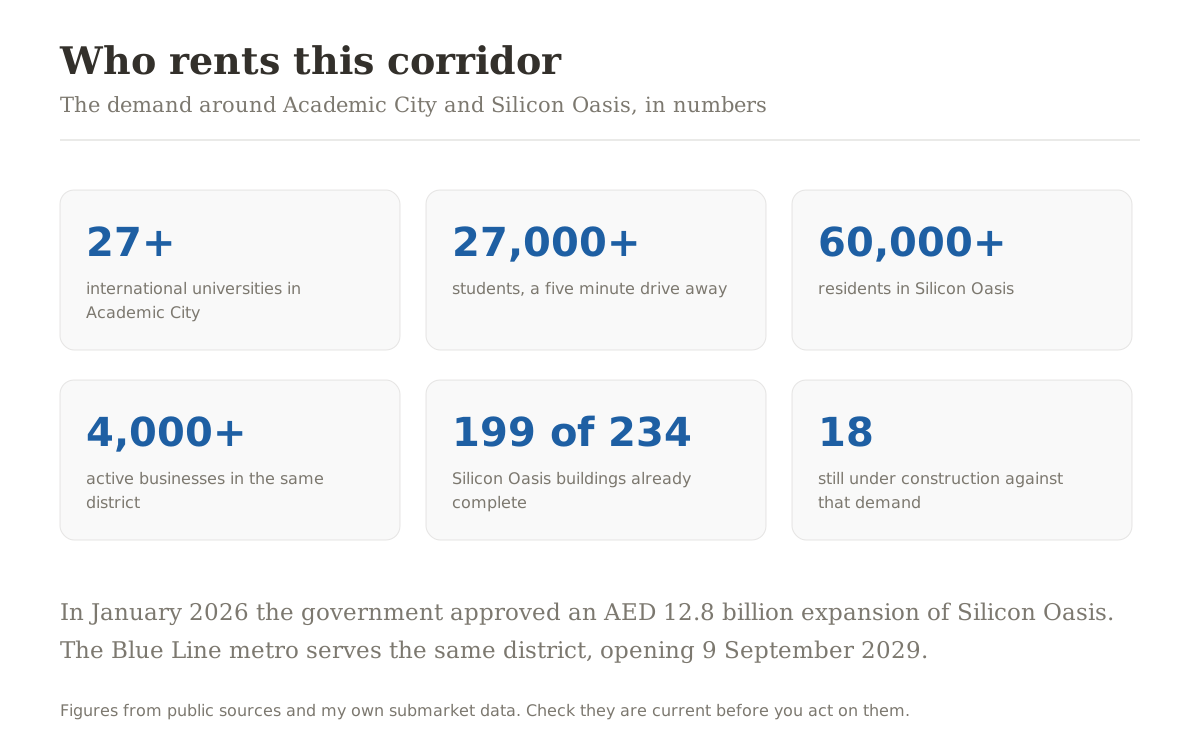
Dubai Academic City is a five minute drive: more than 27 international universities and over 27,000 students. Dubai Silicon Oasis is the other anchor, with more than 60,000 residents and over 4,000 active businesses. The supply picture there is the part I find most useful: of 234 tracked building developments, 199 are already complete and only 18 are currently under construction. That is an ageing stock serving a growing district.
And the district is growing on purpose. In January 2026 the government approved an AED 12.8 billion expansion of Silicon Oasis: District IO at AED 11 billion, targeting more than 6,500 new companies and around 70,000 jobs over a decade, plus Block 14 at AED 1.8 billion for residential and lifestyle, completing in 2029 near the Blue Line station.
Rental yield at The Archive, done honestly
Dubailand Residence Complex is currently printing around 9 percent gross on my own submarket numbers. Here is what that implies, and what the two steps below it imply, so you can see the sensitivity rather than a single flattering figure.
| Unit | At 7% | At 8% | At 9% |
|---|---|---|---|
| Studio, Dh666,000 | Dh46,600 | Dh53,300 | Dh59,900 |
| 1 bed, Dh979,000 | Dh68,500 | Dh78,300 | Dh88,100 |
| 2 bed, Dh1,550,000 | Dh108,500 | Dh124,000 | Dh139,500 |
| 3 bed, Dh1,900,000 | Dh133,000 | Dh152,000 | Dh171,000 |
Those are gross annual rents against the standard plan price, before service charges. Buy the same unit on the post-handover plan and the rent does not change, but your cost does, so the yield on what you actually paid is about a tenth lower. A studio letting at Dh59,900 is 9 percent on Dh666,000 and about 8.2 percent on Dh732,600. That gap is the real price of the tail, and it is the number I would put next to the convenience before deciding. Two things push the real number toward the top of that range here. The units arrive furnished, so there is no fit out cost before the first tenant and furnished stock lets faster in Dubai than empty stock. And the tenant pool five minutes away is students and university staff, for whom a furnished unit with a library downstairs is an easy sell.
One caution on timing that works in your favour. Dubai's rental market shows a real, repeating surge in new contracts in the weeks before September, as students and relocating families settle before the school year. A Q3 2028 handover lands right on that window. That is a genuine piece of luck in the schedule, and it is worth planning your first letting around it.
Service charge, and what you actually keep
Gross yield is a marketing number. Net is the one that pays you, and the gap between them is the service charge. Imtiaz has not published one for this building yet, so what follows is a model rather than a quote.
For a Dubailand tower with this amenity load I would budget Dh12 to Dh16 per square foot a year and plan around Dh14. That is not caution for its own sake. Two rooftop pools, water features, a rooftop garden, an outdoor cinema, mini golf and a staffed two storey library holding ten thousand books are all things somebody maintains, and the owners are the somebody. A library is charming, and it is also an operating line.
At Dh14 per square foot, this is what you would need to charge to hit a given net yield on the standard plan price:
| Unit | Service charge, est. | Rent for 6% net | Rent for 7% net | Rent for 8% net |
|---|---|---|---|---|
| Studio, 360 sqft | Dh5,040 | Dh45,000 | Dh51,700 | Dh58,300 |
| 1 bedroom, 600 sqft | Dh8,400 | Dh67,100 | Dh76,900 | Dh86,700 |
| 2 bedroom, 1,035 sqft | Dh14,500 | Dh107,500 | Dh123,000 | Dh138,500 |
| 3 bedroom, 1,314 sqft | Dh18,400 | Dh132,400 | Dh151,400 | Dh170,400 |
Read it the other way and it is easier to carry in your head. If this submarket keeps printing around 9 percent gross, a studio letting at Dh59,900 pays Dh5,040 of service charge and nets about Dh54,900, which is 8.2 percent on Dh666,000. The one bedroom nets about 8.1 percent, the two bedroom 8.1 and the three bedroom 8.0. So the service charge costs you roughly one percentage point, and the larger the unit the more of it you pay in absolute dirhams even though the percentage barely moves.
Two adjustments before you use any of this. On the post-handover plan you paid 10 percent more for the same unit, so the same rent nets closer to 7.5 percent than 8.2. And if you are not in Dubai, property management takes a further 5 to 8 percent of the rent, which is another half point off the studio.
Put your own unit, your own rent and the developer's actual service charge into the net yield calculator and use its answer rather than mine. If the figure comes back above Dh16 per square foot, redo the whole table before you book.
Imtiaz Developments: the track record
Imtiaz Developments was founded in 1993 and is run by CEO Masih Imtiaz. It is vertically integrated in a way that is unusual at this size: design, construction, joinery, aluminium and glass, investment, property management and after sales are all handled in house. For an off plan buyer that matters, because the more of the chain a developer controls, the fewer of the delays that come from a subcontractor's problem.
In Dubailand Residence Complex specifically, Imtiaz is not a visitor. Of 35 active projects tracked in the submarket, roughly ten are theirs, close to 29 percent, and Cove was their previous launch here. Two further projects are reported for Dubailand Residence Complex and Meydan. A developer with that much of its own name in one postcode has a direct interest in what the postcode is worth, which is a better alignment than a one project developer passing through.
On track record, Construction Week Online reports seven sold out Imtiaz projects in Jumeirah Village Circle with prices up more than 40 percent since. In the same community, on my own market data, a one bedroom from this developer lets at around Dh110,000 a year, above what a typical one bedroom there achieves. And their last two launches sold out completely within hours of opening, which is context for how quickly the better unit numbers here are likely to go.

Portfolio figures for the company vary by source and date, from around AED 6 billion up to AED 15 billion, and from 40 to more than 50 projects. I would not build a decision on any single one of those numbers, and I would ask the developer directly for the current figure rather than quote a broker site.
What I would check before booking
- Confirm which price list you are being quoted. The post-handover plan carries a 10 percent higher price, so a figure quoted without its plan is not a figure. Ask for both, in writing, for the same unit.
- Get the developer's current price list, not a portal's. Every price in this article comes from Imtiaz's own brochure, but launch pricing moves with availability, and the figures circulating on broker sites for this project are not all current.
- Confirm the exact size of the unit you are buying. The brochure prints a studio starting size of 360 sqft on its facts page and a 384 sqft minimum in its typologies table. That gap changes your price per foot by about 7 percent, so pin the actual unit.
- Ask for the service charge estimate. It is not published yet and it is the single line that moves your net yield most. See what service charges really cost.
- Get the furnishing schedule in writing. Fully furnished is a spectrum. Confirm what is included, and note that the specification is a stand shower with no bathtub and no accessories, which matters if you are targeting family tenants.
- Ask what percentage must be paid before the developer will issue an NOC for resale. If your plan is to exit before handover, that number is your plan.
- Check the Blue Line progress figure yourself. It was reported at around 20 percent complete in May 2026 with a 30 percent target for year end. It moves, and anyone quoting it to you as a selling point should be quoting a current number.
My take
Strip the library out and this is a well priced building on the standard plan. The two and three bedroom lines come in under the citywide primary apartment average at a moment when developers are competing hard on price and structure, the units arrive furnished, and the demand case five minutes down the road is students and a district the government just committed AED 12.8 billion to expanding. The post-handover plan is a genuine option rather than a free upgrade: it defers 40 percent past the keys and charges 10 percent for doing so.
Put the library back in and you have the thing most towers in this submarket do not have, which is a reason for a tenant to choose this one over the identical building next door. I read that as a letting edge rather than a valuation premium, and I would underwrite it that way.
Now the objection I expect, and my answer to it. Someone will say a student with money would rather live near Downtown or Palm Jumeirah than out here. Some would. But they cannot buy their way out of the drive. From those addresses Academic City is a rush hour commute in each direction, every day of term, and no budget shortens it. Students optimise for two things, sleeping later in the morning and staying out after class, and a five minute drive gives them both. That is the whole reason studios and one bedrooms let well against this catchment. The two and three bedroom serve a different tenant: the family that lives and works inside the same corridor and wants the same short commute.
The other thing I would not overlook is the date. Q3 2028 is two years away. A lot of what is being launched in Dubai right now hands over in 2029 or 2030, often inside master plans that need another phase or two before the neighbourhood feels finished. Two years means your capital starts earning two years sooner, and because off plan appreciation clusters around completion, it also means you reach that window sooner. On a building priced at market rather than above it, that shorter build is worth more than anything on the amenity list. It is the same reason I was cool on a 2030 handover priced above ready stock.
Who it suits: an investor buying a studio or one bedroom for the student catchment; an investor buying the two bedroom, where the price per foot is best, for a family working in the corridor; and an end user who genuinely wants the library and can hold to 2028. Take the standard plan if your cash is free and the tail if it is not. Who it does not suit: anyone taking the tail without pricing the 10 percent, anyone underwriting a studio on gross yield with no service charge in the model, and anyone who needs a metro station on day one.
If you want the live availability, the current price list and the unit numbers that actually have the views rather than the wall, message me. The better numbers in a launch like this do not stay on the list long.
Sources: prices, sizes, payment schedules, building configuration and the amenity list are from Imtiaz's official brochure for The Archive. Citywide price per square foot benchmarks are from Dubai Land Department data as compiled in my July 2026 market report. Jumeirah Village Circle track record via Construction Week Online. Silicon Oasis expansion figures from the January 2026 government announcement. Submarket project counts, yield and rental figures are my own data. Provided for information only, not financial or investment advice.
Frequently asked questions
The Archive is an off plan residential tower by Imtiaz Developments in Dubailand Residence Complex (DLRC), launched in August 2026 and handing over in Q3 2028. It is basement, ground, three podium levels, thirteen residential floors and a roof, and it is built around a two storey working library that replaces the lobby. Studios, one, two and three bedroom apartments are delivered fully furnished, freehold to all nationalities.
In Dubailand Residence Complex, usually written DLRC, off Sheikh Zayed Bin Hamdan Al Nahyan Road with Al Ain Road and Emirates Road close by. The route is toll free, so no Salik. Dubai Academic City and Dubai Outlet Mall are a five minute drive, IMG Worlds and Global Village ten minutes, and Downtown Dubai, Dubai Creek Harbour and the airport twenty minutes, on the developer's published off peak times.
On the standard 50/50 plan, studios start at Dh666,000, one bedrooms at Dh979,000, two bedrooms at Dh1,550,000 and three bedrooms at Dh1,900,000. Both plans open with 20 percent plus the 4 percent DLD fee and an admin fee on booking. The 50/50 plan then pays 5 percent on six set dates and 50 percent on completion. The 60/40 post handover plan defers 40 percent over three years after the keys at 3.3 percent a quarter, and is priced 10 percent above the standard list.
Twenty percent of the price, plus the 4 percent DLD registration fee and an admin fee. On the standard plan a studio is Dh133,200 plus Dh26,640 of DLD fee, so under Dh160,000 books it before the admin fee. On the post handover plan the same studio is priced at Dh732,600, so booking is Dh146,520 plus Dh29,304, closer to Dh176,000.
Studios start at 360 sqft, one bedrooms at 600 sqft, two bedrooms at 1,035 sqft and three bedrooms at 1,314 sqft. Across the building sizes run from 384 to 1,884 sqft including balconies, and the one bedroom is published in two layouts. Note a discrepancy in the developer's own brochure: the facts page prints a 360 sqft studio and the typologies table prints 384 sqft, which moves the price per square foot by about 7 percent. Individual floor plans are released per unit on request rather than published as a set.
Q3 2028. The instalment schedule between now and then is set on calendar dates rather than construction milestones: 15 November 2026, 1 April 2027, 15 August 2027, 1 November 2027, 15 February 2028 and 1 July 2028. That means your payments do not slow down if the build does, so budget against the published dates.
Yes. The tenure is freehold and open to all nationalities, and the project is registered with a Dubai Land Department escrow account. On the post handover plan a three bedroom starts at Dh2.09M, which clears the Dh2M golden visa threshold at the entry size; on the standard plan at Dh1.9M it does not.
Eighteen, four of them reading spaces: the two storey library holding around ten thousand books, the Writer's Room, the Reading Lounge and a rooftop Reading Salon with a fireplace and firepit. The rest are a gym, adult and kids rooftop pools, floating cabanas over a shallow water feature, a rooftop terrace garden, an outdoor cinema, a barbecue lounge, mini golf, a kids play area and a pets area. Units are handed over fully furnished, with a stand shower and no bathtub.
On the standard plan, yes for the larger units. A studio is about Dh1,850 per sqft, a one bedroom Dh1,632, a two bedroom Dh1,498 and a three bedroom Dh1,446, against a July 2026 citywide primary apartment average of Dh1,724 and a resale average of Dh1,449. The two and three bedroom sit below the primary average and the three bedroom lands almost exactly on the resale average. On the post handover plan every line is 10 percent higher, which puts the one bedroom above the primary average rather than below it.
Imtiaz has not published one yet, so any figure you are quoted is an estimate. For a Dubailand tower carrying two rooftop pools, water features, a rooftop garden, an outdoor cinema, mini golf and a staffed two storey library, I budget Dh12 to Dh16 per square foot a year and plan around Dh14. At Dh14 that is roughly Dh5,040 a year on a 360 sqft studio and Dh18,400 on a 1,314 sqft three bedroom, and it costs you about one percentage point of yield. If the developer's figure comes back above Dh16, redo the numbers before you book.
Dubailand Residence Complex is currently printing around 9 percent gross on my own submarket numbers. At an estimated Dh14 per square foot service charge, that nets about 8.2 percent on a studio, 8.1 percent on a one bedroom, 8.1 on a two bedroom and 8.0 on a three bedroom, measured against the standard plan price. Buy the same unit on the post handover plan and you paid 10 percent more for the same rent, so net lands closer to 7.5 percent. Overseas owners should take a further 5 to 8 percent of rent off for property management.
Dubai Academic City is five minutes away with more than 27 international universities and over 27,000 students, and Dubai Silicon Oasis has more than 60,000 residents and over 4,000 businesses. At 9 percent gross on the standard plan price that implies about Dh59,900 a year for a studio, Dh88,100 for a one bedroom, Dh139,500 for a two bedroom and Dh171,000 for a three bedroom. Units arrive furnished, which lets faster in Dubai, and a Q3 2028 handover lands on the pre September letting surge.
Not today. There is no station inside Dubailand Residence Complex and one is planned on Emirates Road. The Blue Line, which serves Dubai Silicon Oasis and Academic City by name, is under construction and opens on 9 September 2029, a year after this building hands over. Treat it as a benefit to the hold rather than to day one, and check the current completion figure yourself rather than accepting a broker's number.