Most buyers never ask what triggers each instalment until the site slows down. This is Part 6 of my guide to The WOW Tower: the difference between plans that follow the calendar and plans that follow the building, what Dubai's escrow law does and does not cover, why Abu Dhabi works differently, and what happens to your money in a delay under each structure.
The short version
- A date-based plan asks for money on fixed dates, whatever the site is doing. A construction-linked plan asks for it when the building reaches agreed stages.
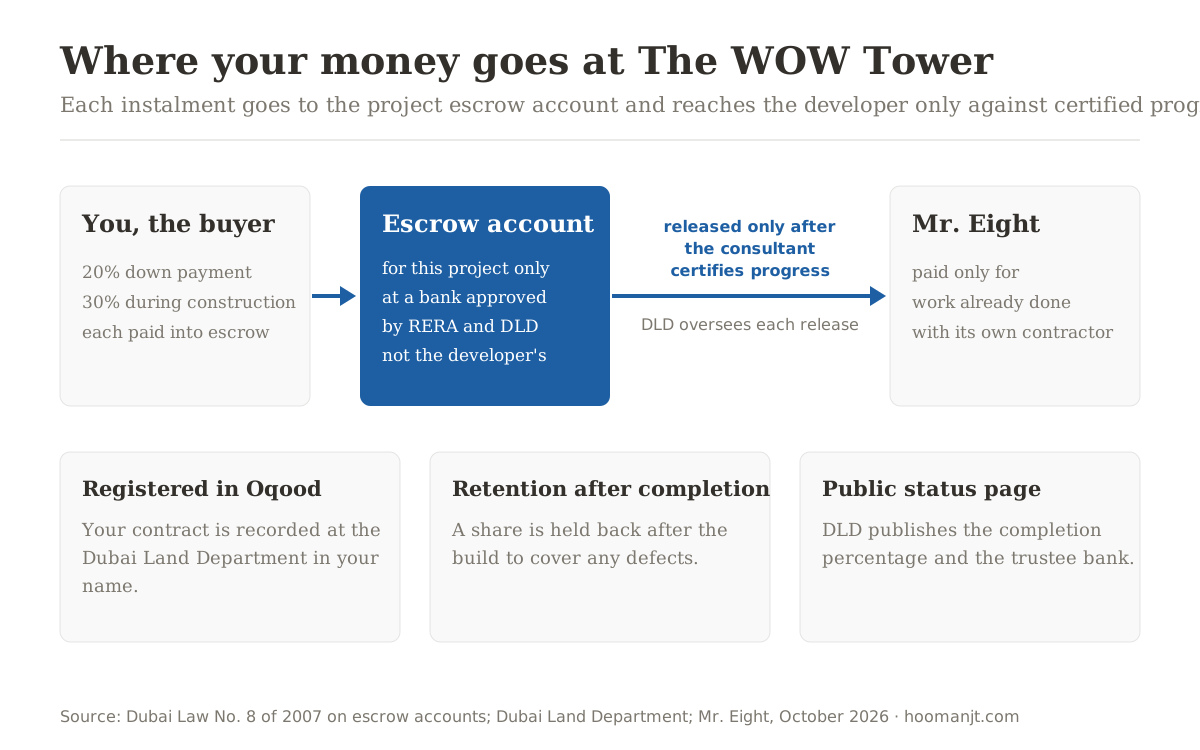
- Dubai law protects your money through the project escrow account: it can only be released for that project, against construction progress certified by the trustee bank's engineer. It does not tie your instalments to that progress.
- Abu Dhabi's law does: the buyer pays according to the actual completion percentage unless the contract says otherwise, and no escrow money moves before 20% of the building is done.
- In DLRC, eight projects have already passed their registered completion month at 24% to 87% complete. Delays are normal; what matters is whether your payments wait with the building.
- At The WOW Tower, the 30% due during construction is tied to progress. The 20% at booking and the 50% after handover are not.
Date-based and construction-linked plans: the difference
A date-based plan reads like a calendar: 10% in April 2027, 5% in August 2027, and so on. If the site is on schedule you will not notice the difference. If it falls behind, you keep paying on the dates, and you have paid for more building than exists.
A construction-linked plan reads like a construction programme: 10% when the structure reaches a stated percentage, 10% at the next stage. If the site falls behind, the next instalment waits. Your cash stays with you until the work it pays for is done.
The plans of the other DLRC projects I could read on their developers' own pages are date-based. The Archive's two plans are set by calendar dates in Imtiaz's August 2026 brochure. Samana's plans for Parkville and Ibiza are monthly percentages from the booking date. Wadan does not publish the stages of its Weston plans. Mr. Eight is the exception: its plans mix dated and milestone instalments, and at The WOW Tower the whole construction share is milestone-based.
What Dubai law requires: escrow, not milestones
Dubai's off-plan buyers are protected mainly by Law No. 8 of 2007 on escrow accounts. Its working rules, as the Dubai Land Department explains them:
- A developer must open an escrow account for each project before selling off-plan, and every payment from buyers goes into it, in the name of that project.
- The escrow agreement lists the major construction stages. Money is released only after the trustee bank's engineer has checked on site that a stage is complete.
- 5% of the money paid is kept in the account for one year after completion, against defects.
- If a project is cancelled, the account passes to DLD's project liquidation department, which asks the developer to return buyers' money within 60 days of the cancellation decision.
The register side is Law No. 13 of 2008. Every off-plan sale is recorded in the interim register, Oqood, which is your proof of ownership until the title deed is issued. The same law sets what happens when a buyer stops paying. After a 30-day notice through DLD, a developer may cancel and keep up to 25% of the unit's contract value if construction is below 60%, and up to 40% if it is above 60%, under the 2017 amendment; if work has not started, up to 30% of what the buyer has paid.
What none of this does is link the buyer's schedule to the building. The escrow rules control when the developer can take money out, not when you must put it in. The schedule is whatever the contract says.
Why Abu Dhabi links payments to construction and Dubai usually does not
Abu Dhabi wrote progress into the buyer's side. Law No. 3 of 2015, which governs its real estate sector, says the buyer "shall be bound to pay the value of the off-plan real estate unit according to the actual completion percentage of the construction works, unless otherwise agreed with the developer." Its rules also say no escrow money may be paid out until the developer has completed at least 20% of the construction.
So in Abu Dhabi a progress-linked plan is the default and a dated one is the exception. In Dubai it is the other way round. My reading of why: dated plans give developers a predictable cash flow they can borrow against and market as "1% a month", and Dubai buyers have accepted them for years because escrow already stops the money being used elsewhere.
That trust is reasonable as far as it goes. Escrow stops misuse. It does not stop you paying early for a building that is late.
What happens to your money during a delay, under each structure
| Situation | Date-based plan | Construction-linked plan |
|---|---|---|
| Site slows down | You keep paying on the dates | The next instalment waits for the stage |
| Money already paid | In escrow, released only against certified progress | Same |
| Developer misses the completion date | The SPA's delay clause applies; compensation is usually capped and starts late | Same, but you have paid less in the meantime |
| Project cancelled by the regulator | DLD asks the developer to refund within 60 days | Same |
| You stop paying | Up to 25% or 40% of the contract value can be kept, by stage | Same |
| Building finishes early | Check the SPA: some contracts bring later instalments forward | Same |
The legal protections are the same. What changes is how much of your money is already in the project when something goes wrong.
DLRC's own record: completion dates against progress
DLD's project register, as shown on DXB Interact on 7 October 2026, lists 46 off-plan projects in DLRC with their registered completion dates and their actual completion percentages. Eight have already reached their completion month without being finished:
| Project | Registered completion | Complete on 7 Oct 2026 |
|---|---|---|
| Dalmore Tower | April 2026 | 87% |
| Time 2 | June 2026 | 87% |
| Samana Ivy Gardens | June 2026 | 27% |
| Weybridge Gardens 3 | August 2026 | 24% |
| Cove Edition Residence 1 | August 2026 | 66% |
| AG Square | September 2026 | 69% |
| AG Central | October 2026 | 59% |
| Cove Edition Residence 2 | October 2026 | 50% |
Registered dates are often original estimates that contracts allow to be extended, so this is not proof of breach by any of these developers. It is evidence that in DLRC, as in most of Dubai, a building finishing after its first date is the normal case. A plan that pays on dates puts the cost of that delay on the buyer.
The WOW Tower's structure
The WOW Tower's plan has three parts, and only one waits for the building.
- The 20% at booking goes into the project escrow account. The developer opened the account in October 2026; its number and the trustee bank are written in your SPA.
- The 30% during construction is paid in stages tied to progress, as the SPA sets them. If the build slows, these instalments slow with it.
- The 50% after handover is paid once the building is complete. At that point the escrow account has done its job; in Dubai, payments after completion are made to the developer.
Two more layers of oversight are available here. Once the project is registered, DLD's project status page will show its completion percentage; how to read it is in my guide to tracking off-plan construction progress. And Mr. Eight streams its sites live on YouTube; a camera for The WOW Tower has been announced and was not yet live on 7 October 2026. The developer's record is in Part 1, and the whole payment plan, year by year, in Part 5.
Five clauses to read in any off-plan SPA
- The schedule: which instalments are dated and which wait for a construction stage, and who certifies that a stage is reached.
- The completion date: the expected date, and how much longer the developer may extend it, and how.
- Delay compensation: when it starts, how it is calculated and whether it is capped.
- Early completion: whether later instalments, including post-handover ones, become due if the building finishes early.
- The escrow details: the account and the bank written into the contract, and the instruction to pay only there.
The full pre-booking list, with what Mr. Eight offers on each point, is Part 11. How to read a developer's plan line by line is in decoding developer payment plans.
Sources and dates
- Dubai escrow: Law No. 8 of 2007 (Dubai Legislation Portal); DLD Frequently Asked Questions on escrow releases, the 5% retention under Article 14 and refunds within 60 days of a cancellation. Read 7 Oct 2026.
- Interim register and buyer default: Law No. 13 of 2008, Article 11 as amended by Law No. 19 of 2017, Explanatory Notes (Dubai Legislation Portal), read 7 Oct 2026.
- Abu Dhabi: Law No. (3) of 2015 Concerning the Regulation of the Real Estate Sector, and its executive regulations, ADREC copies, read 7 Oct 2026.
- Other DLRC plans: Imtiaz brochure for The Archive (4 Aug 2026); samanadevelopers.com; wadan.ae. Read 7 Oct 2026.
- DLRC completion dates and percentages: DXB Interact Offplan Hub (DLD project data), 7 Oct 2026.
- The WOW Tower plan and escrow: the developer's October 2026 terms; payments to escrow and after completion: the developer's SPA (general points only).
- Mr. Eight live cameras: the developer's YouTube channel, checked 7 Oct 2026. Cover: frame from Mr. Eight's live camera on Villa del Brunello, Dubai Islands, 7 Oct 2026; The WOW Tower camera was not yet live.
Request exclusive pricing
Starting prices are public in this guide. The full price list, the units still available and the offers that apply to them I send directly. Four details, and WhatsApp opens with your message ready to send.
Frequently asked questions
A plan where instalments fall due when the building reaches agreed construction stages, rather than on fixed dates. If the site slows, the next payment waits. In a date-based plan you pay on the dates whatever the site is doing.
No. Most Dubai developers set instalments by date or as monthly percentages. Of the DLRC plans I could read on developers' own pages in October 2026, only Mr. Eight's tied instalments to construction stages.
Because the law says so by default. Abu Dhabi's Law No. 3 of 2015 makes the buyer pay according to the actual completion percentage of the construction unless agreed otherwise, and allows no escrow payout before 20% of the building is complete.
What you have paid stays in the project's escrow account and is released to the developer only against certified progress. What you have not yet paid depends on your plan: on a date-based plan you keep paying on the dates; on a construction-linked plan the next instalment waits.
The escrow account passes to DLD's project liquidation department, which asks the developer to return buyers' money within 60 days of the cancellation decision.
No. Under Law No. 8 of 2007 every buyer payment goes into that project's own escrow account, and money is released only for that project, against construction stages checked by the trustee bank's engineer.
After a 30-day notice through DLD, a developer may cancel and keep up to 25% of the unit's contract value if construction is below 60%, and up to 40% if it is above 60%, under Law No. 13 of 2008 as amended in 2017. If work has not started, the limit is 30% of what you have paid.
Partly. On the 50/50 plan, the 30% due during construction is paid in stages tied to progress, the 20% at booking is paid up front into escrow, and the 50% after handover is paid over 18 or 36 months once the building is complete. On the 35/65 plan, 35% is paid during construction and 65% on handover.
On DLD's project status page, which shows each registered project's completion percentage, status and escrow trustee. Some developers, Mr. Eight among them, also stream their sites live.