
The short version
- A Dubai developer has moved several projects from a 20/80 payment plan to 50/50 with two years of instalments after handover. That includes projects it was selling on 20/80 until recently.
- On a Dh2M unit handing over in three years, at a 5% cost of money, the buyer who signed first pays only about Dh6,500 more in today's money. That is 0.33% of the price. With handover in two years it is about Dh21,000, or 1.06%.
- The real gap is risk, not money. The first buyer needs Dh1.6M on handover day. The new buyer needs nothing that day.
- If the bank values the unit 10% below the price, a resident buyer has to find about Dh160,000 of their own money. A non-resident has to find about Dh520,000.
- Selling 20% below the price at handover wipes out the whole 20% already paid, plus the 4% DLD fee.
- These units yield about 5% gross and 3 to 4% net. A one-year dirham deposit at a UAE bank pays 4.1 to 5%, with no price risk.
Stop here and you have the answer. The rest is the working, for anyone who wants to check each number.
What changed, and why I am not naming the developer
The old plan was 20/80: 20% of the price during construction and 80% on handover. The new plan is 50/50: half by handover, half in instalments over the two years after it. The change also covers projects that were offered on 20/80 until recently.
I am not naming the developer or the projects. This is not about one company. Any developer can do the same thing, and I want to show with numbers what it does to the buyer who signed first and to the market around them.
To be fair to the developer: it is entitled to set new terms on units it has not sold yet. Nothing here breaks a rule.
Two neighbours, one price, two payment plans
Take two identical apartments on the same floor of the same building. Both cost Dh2,000,000. The first buyer signed two months ago on 20/80. The second buyer signs today on 50/50 with two years after handover.
My assumptions: handover in three years. Both pay 10% on booking. The rest of the construction share goes in equal monthly instalments up to handover. The new buyer's last 50% goes in 24 equal monthly instalments after handover. Both pay the same 4% DLD fee on booking.
| Stage | First buyer, 20/80 | New buyer, 50/50 plus 2 years |
|---|---|---|
| Booking, with the 4% DLD fee | Dh280,000 | Dh280,000 |
| Instalments during construction | Dh200,000 | Dh800,000 |
| Total paid before handover | Dh480,000 | Dh1,080,000 |
| Handover day | Dh1,600,000 | Dh0 |
| After handover | Dh0 | Dh41,667 a month for 24 months |
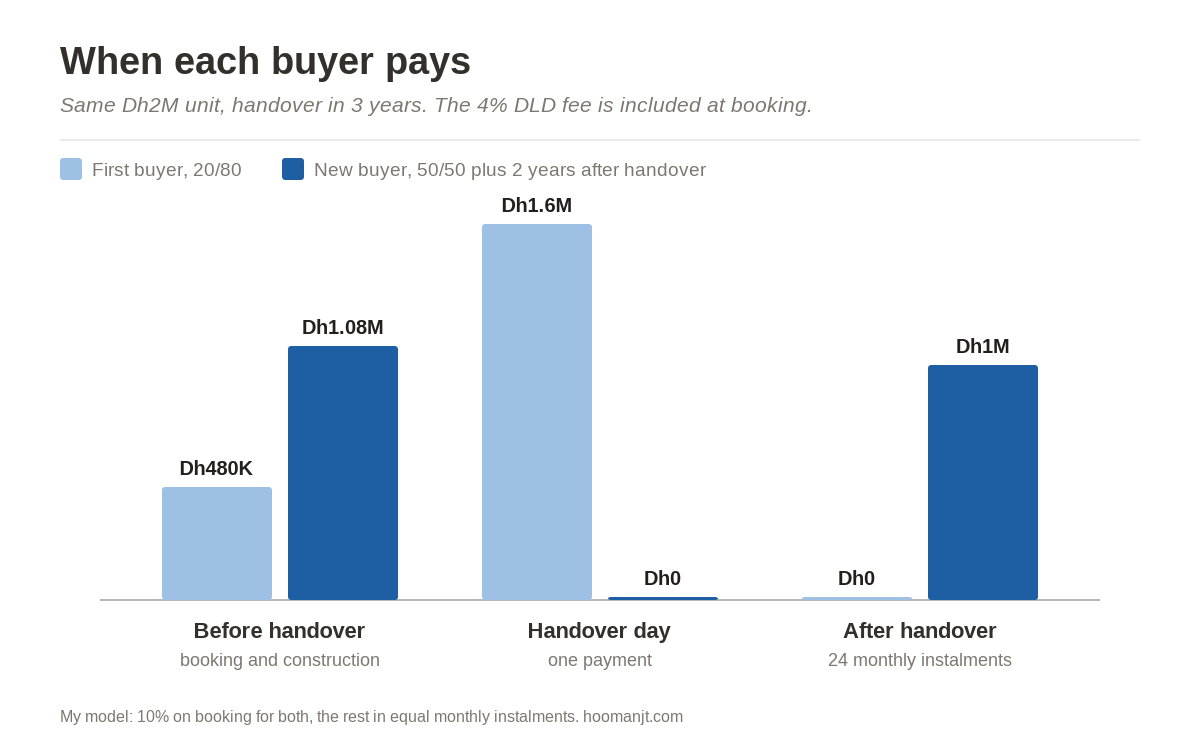
The two columns tell different stories. The first buyer has paid Dh600,000 less while the building goes up, and that money stays in the buyer's pocket until handover. Then the full Dh1.6M falls due in one go. The new buyer puts more money in early, pays nothing on handover day and collects the keys.
The new plan is not easy either. Dh41,667 a month after handover is a heavy instalment. At a 5% gross yield the same unit rents for about Dh8,300 a month, so the new buyer still has to find around Dh33,000 a month of their own money for two years.
20/80 vs 50/50 post-handover at a 5% cost of money
To compare the plans fairly, I bring every payment back to today's money. A dirham paid in three years costs less than a dirham paid today, because the money can earn something in the meantime. I use 5% a year, as if the cash sat in a deposit.
At 5%, everything the first buyer pays is worth about Dh1,770,600 today. Everything the new buyer pays is worth about Dh1,764,100. The gap is about Dh6,500, or 0.33% of the price.
That gap is two large numbers that nearly cancel out.
- The new buyer pays 30% of the price earlier, during construction. In today's money that costs about Dh37,600 of lost interest.
- The new buyer then pays 50% of the price over two years after handover instead of on the day. That saves about Dh42,500.
- The last Dh1,600 or so is the first buyer paying the booking two months earlier.
So on money alone, the first buyer has lost less than most people assume. The number does move with the handover date:
| Handover in | First buyer's extra cost, today's money | % of price |
|---|---|---|
| 2 years | about Dh21,100 | 1.06% |
| 3 years | about Dh6,500 | 0.33% |
| 4 years | about Dh7,100 in the first buyer's favour | minus 0.36% |
If the first buyer paid the whole 20% on booking day, those three numbers become about Dh31,400, Dh21,400 and Dh12,000. That is 1.57%, 1.07% and 0.60%.
There is one cost that only the first buyer carries. Most people who choose 20/80 plan from day one to pay the 80% with a mortgage. Registering a Dh1.6M mortgage at DLD costs 0.25% of the loan plus Dh290, about Dh4,300. Most banks charge a processing fee of up to 1% of the loan, and the valuation costs about Dh2,500 to Dh3,500. That adds Dh7,000 to Dh24,000.
With those fees, the first buyer is Dh13,000 to Dh30,000 behind on a three year handover, which is 0.7% to 1.5% of the price. On a two year handover the gap is Dh28,000 to Dh45,000, 1.4% to 2.2%.
My reading: the direct money loss is 0.7% to 2.2% of the price, depending on the handover date and the mortgage fees. The bigger loss sits somewhere else. It sits in confidence, on handover day and in the resale market.
What stops the plan changing again in two months?
A payment plan is part of the price. When a developer changes the terms on the same project soon after selling units in it, the next buyer has every right to ask: what stops a five year post-handover plan arriving two months from now?
The honest answer is nothing. Your SPA fixes the terms of your unit. It does not stop the developer changing the terms on the units it still has to sell.
You can see the effect in how buyers behave. A buyer who watches the terms keep getting better waits. When buyers wait, sales slow, and the usual answer to slow sales is another incentive. That loop wears down trust in the price list. In a market where a large share of buyers live abroad and cannot follow it week by week, that trust matters a great deal.
It is worth looking at the change from the developer's side too. On 50/50 it collects Dh1,000,000 before handover instead of Dh400,000, and it waits up to two years for the rest. I read that as the developer seeing the same weak point I see in 20/80: handover day, when a large number of buyers have to pay 80% at the same time.
Handover day: when the bank valuation comes in below the price
Most 20/80 buyers are counting on a mortgage for the last 80%. But a bank does not lend on the developer's price. It lends on the lower of two numbers: what you paid, or what its valuer says the unit is worth at handover.
A resident buying a first home under Dh5M can borrow up to 80%. A non-resident usually gets 50 to 60%, and I use 60%, the top of that range. Here is how much the first buyer, who owes Dh1.6M on handover day, has to add from their own pocket:
| Bank valuation | Extra cash, resident (80% loan) | Extra cash, non-resident (60% loan) |
|---|---|---|
| At the price, Dh2.0M | Dh0 | Dh400,000 |
| 10% below, Dh1.8M | Dh160,000 | Dh520,000 |
| 20% below, Dh1.6M | Dh320,000 | Dh640,000 |
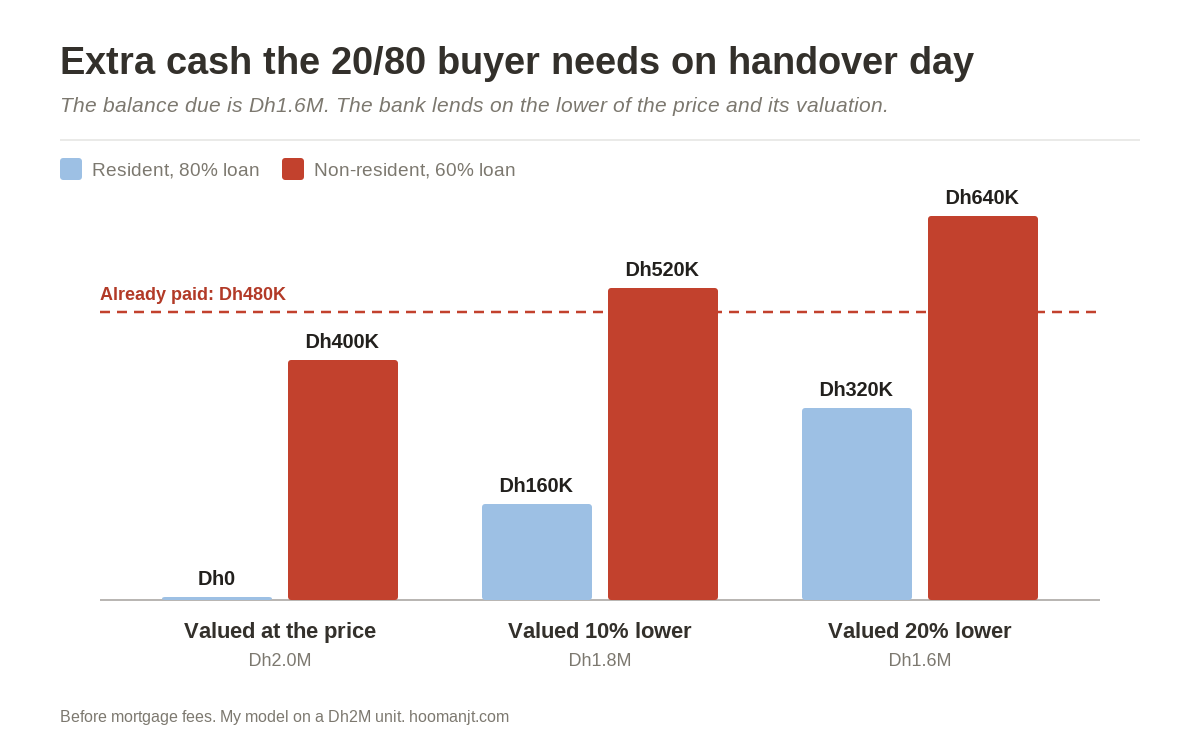
Those numbers are before mortgage fees. A non-resident who was counting on 80% needs another Dh400,000 even if the valuation matches the price exactly. If the bank values the unit 10% lower, the figure is Dh520,000. That is more than everything paid up to that day.
Selling 20% below the price wipes out the whole deposit
A buyer who does not have that cash has two options. The first is to sell. Other buyers in the same building are in the same position at the same time, so sales happen at a discount, and in a building full of sellers that discount can reach 20% of the original price.
The arithmetic is short. Sell the Dh2M unit for Dh1.6M and the whole amount goes to the developer for the 80% still owed. Nothing comes back. The seller has lost Dh400,000 of instalments and Dh80,000 of DLD fee. Add 5% a year of opportunity cost on that Dh480,000 up to handover and it is about Dh63,000 more. The total loss is about Dh543,000, or 27% of the price, before any agency fee.
The second option is to pay the gap from your own pocket and hold until the market comes back to your breakeven. But the real breakeven is not the price you paid.
Say you pay the full 80% in cash, rent the unit for three years and earn 3.5% net. To get all your money back plus 5% a year, you have to sell for about Dh2.25M. That is 12.7% above what you paid, and 41% above the Dh1.6M the market offered on handover day. Prices coming back to Dh2M does not make you whole.
How distressed resales pull down the price per square foot
Many 20/80 buyers planned to sell at handover and take a profit. That is what the plan is good for: little money in during construction, out before the big payment. If there is no shortage of supply in the area at handover, a lot of them try to sell at once and compete with each other for the same buyers.
The damage does not stay in one building. Every sale below the price is registered at DLD and drags down the area's average price per square foot. Bank valuers use those same registered sales as comparables. So each distressed sale pushes the next valuation lower, widens the next buyer's mortgage gap and makes the next distressed sale more likely. That loop can run for months.
Many of these buyers are international. An investor who bought in Dubai once, did not get the returns they expected and lost part of their capital is unlikely to invest here again, and they tell the people around them why. That cost lands on the whole market, not on one project.
A 5% gross yield against a 4 to 5% bank deposit
These units are priced so high that the gross rental yield does not go much above 5%. On a Dh2M unit that is about Dh100,000 of rent a year. After service charge, maintenance, letting fees and empty months, the net yield is 3 to 4%, or Dh60,000 to Dh80,000.
Compare that with cash. First Abu Dhabi Bank pays 4.10 to 4.20% on a one-year dirham deposit, depending on the balance. Dubai Islamic Bank's one-year wakala deposit tops StashAway's November comparison at an expected 5.05%, which is a target, not a guarantee. The UAE Central Bank held its Base Rate at 3.90% on 28 October.
| Option | Yearly return | On Dh2M | Price risk |
|---|---|---|---|
| Gross rental yield | about 5% | about Dh100,000 | Yes |
| Net rental yield | 3 to 4% | Dh60,000 to Dh80,000 | Yes |
| FAB one-year deposit | 4.15% at this balance | about Dh83,000 | No |
| DIB one-year wakala | 5.05% expected | about Dh101,000 | No |
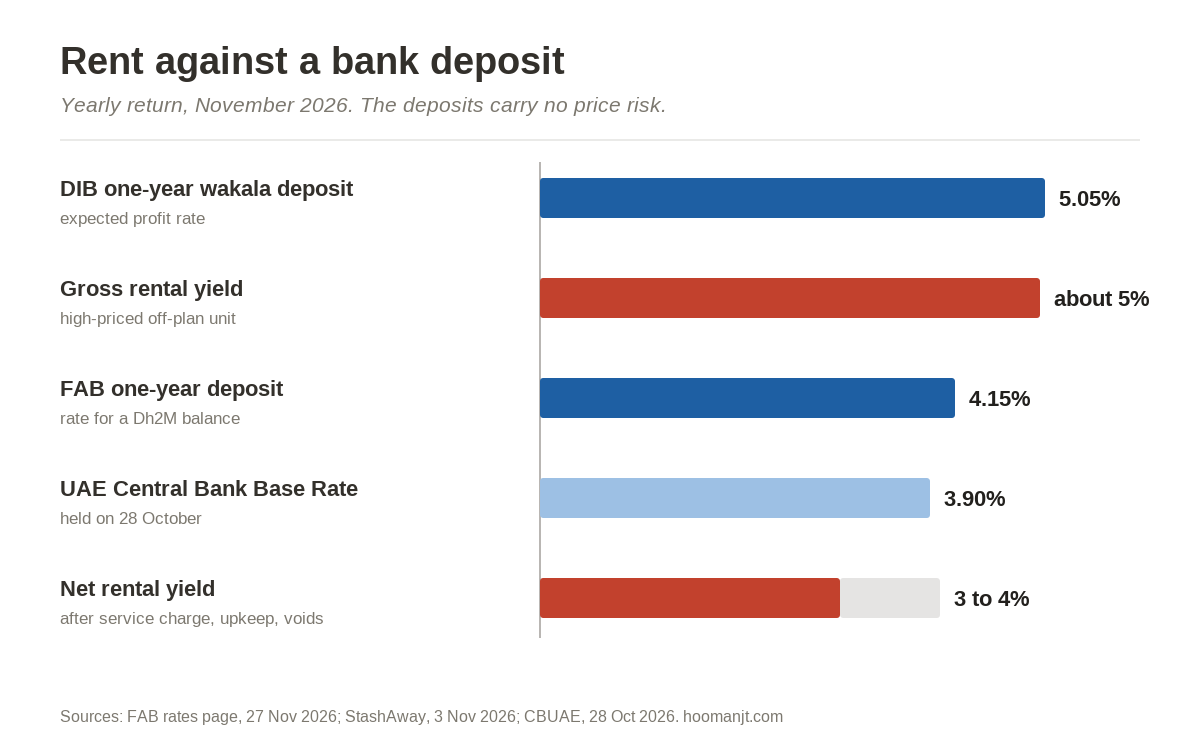
So the net yield is below a bank deposit, and the gross yield at best matches the best deposit on offer. The difference is the risk. A deposit has no service charge and no empty months, and if the market falls 20%, your capital is still there.
To be fair, deposit rates move with the US Federal Reserve because the dirham is pegged, so they can fall, while rents can rise. On today's numbers, though, the deposit wins.
A smart investor has another route here. Buy a small ready studio, use it for the two-year investor residency, get the Emirates ID, open a resident bank account and put the rest of the money on deposit. Since spring 2026 full ownership of a completed, DLD-registered property of any value qualifies for that visa, and the fees usually run Dh4,000 to Dh7,000. I wrote up the rules in my guide to Dubai residency and the Golden Visa through property. Small studios in established areas also tend to rent at a higher yield than large, expensive units.
Why waiting for handover can be the better entry
If you have a real reason to want this particular project, I think it makes more sense to wait for handover and look for a distressed sale. Those can come in up to 20% below the developer's original price. Waiting gives you more than the discount:
- The building is finished. You judge the build quality with your own eyes, not from renders.
- You pick the unit yourself and see which ones have the good view and which ones look straight into the next tower.
- The service charge, the real rents of similar units and the bank valuation are all known before you buy.
- You have no money tied up during construction, and someone else carries the risk of a late handover.
- The money you did not pay the developer earns interest in the bank in the meantime.
The cost of waiting is clear too. If the market rises in the meantime and no distressed sellers appear, you may pay more. On the numbers above, I still think that risk is smaller than buying a unit that depends on an 80% mortgage on handover day.
Whose fault is it?
The developer has done nothing illegal. It changed the terms on its own unsold units. In my view the responsibility sits in two other places.
The first is the investor who did not study the market well enough and did not get the right advice. Every question in this article had an answer before the contract was signed. How much do I pay on handover day? What do I do if the bank values the unit lower? How does my net yield compare with a bank deposit?
The second is advice that follows the hype. When a project is recommended because everyone else is buying it, that hype is the reason people clicked on the ad or the promotion in the first place. As brokers, our job is to run these numbers for the client before recommending any project, even when the answer is not to buy yet.
What I would check before signing any off-plan payment plan
- The amount due on handover day, and exactly where it will come from: cash, a mortgage or a sale.
- A mortgage pre-approval before booking, plus the gap you would face if the valuation came in 10% or 20% under the price. If you are a non-resident, run it at 50 to 60%.
- The price per square foot against resale transactions in the same area, not only against other off-plan launches.
- How many other units hand over in the same area in the same year.
- The net rental yield, compared with a one-year deposit rate.
- Whether you can hold the unit for three years or more if a sale at handover does not work out.
You can put any two payment plans on one timeline with the payment plan comparator. The mortgage side is in my guide to UAE off-plan mortgages during construction, and the rate background is in my piece on the UAE Base Rate at 3.90%.
Assumptions and sources
- Example unit Dh2,000,000. Handover three years from today. Opportunity cost 5% a year, compounded monthly. 10% on booking for both buyers, the rest of the construction share in equal monthly instalments, the post-handover 50% in 24 monthly instalments. All calculations are mine.
- Loan limits: up to 80% for a resident's first home under Dh5M under UAE Central Bank rules; 50 to 60% for non-residents under common bank policy.
- Mortgage costs: DLD mortgage registration 0.25% of the loan plus Dh290; bank processing fee up to 1%; valuation Dh2,500 to Dh3,500.
- First Abu Dhabi Bank, fixed deposit rates page, updated 27 November 2026: one year 4.10% up to Dh1M, 4.15% up to Dh5M, 4.20% above Dh5M.
- StashAway UAE fixed deposit comparison, rates as of 3 November 2026: Dubai Islamic Bank monthly profit wakala, 5.05% expected, minimum Dh25,000.
- UAE Central Bank, 28 October 2026: Base Rate held at 3.90%.
- Two-year property residency rules: my Dubai residency and Golden Visa guide.
Frequently asked questions
You pay 20% of the price during construction and 80% on handover. On a Dh2M unit that is Dh400,000 before handover, plus the Dh80,000 DLD fee at booking, and Dh1.6M on handover day.
Half the price is paid by handover and half over the two years after it. On a Dh2M unit with the last 50% in 24 monthly instalments, each instalment is Dh41,667, while the same unit rents for about Dh8,300 a month at a 5% gross yield.
They are close. With handover in three years, the 20/80 buyer pays about Dh6,500 more in today's money on a Dh2M unit, 0.33% of the price. With handover in two years the gap is 1.06%. With handover in four years, 20/80 comes out about 0.36% cheaper.
In direct money, 0.7% to 2.2% of the price depending on the handover date and mortgage fees, or about Dh13,000 to Dh45,000 on a Dh2M unit. The bigger loss is risk: that buyer owes Dh1.6M on handover day and the new buyer owes nothing that day.
The bank lends on the lower of the price and its valuation. If a Dh2M unit is valued 10% lower, a resident on an 80% loan has to add about Dh160,000 of their own money, and a non-resident on a 60% loan about Dh520,000.
Banks usually lend non-residents 50 to 60% of the value, against up to 80% for a resident buying a first home under Dh5M. So a non-resident buying a Dh2M unit on 20/80 is about Dh400,000 short on handover day even if the valuation matches the price.
On a Dh2M unit, a Dh1.6M sale only covers the 80% still owed to the developer. The Dh400,000 of instalments and the Dh80,000 DLD fee are gone, and with a 5% opportunity cost the loss is about Dh543,000, or 27% of the price, before any agency fee.
Not the purchase price. A 20/80 buyer who pays the 80% in cash, rents for three years at 3.5% net and wants their money back plus 5% a year has to sell for about Dh2.25M on a Dh2M unit, 12.7% above the price.
For high-priced units, often yes. First Abu Dhabi Bank pays 4.10 to 4.20% on a one-year dirham deposit (27 November 2026) and Dubai Islamic Bank's wakala deposit has an expected 5.05%. The net rental yield on such a unit is 3 to 4%.
Yes. Since spring 2026, full ownership of a completed, DLD-registered property of any value qualifies a sole owner for the two-year investor residency. Fees usually run Dh4,000 to Dh7,000, and an off-plan unit does not qualify.
Not on your unit: your SPA fixes your terms. On the units it has not sold, it can announce new terms at any time, including longer post-handover plans, and nothing in your contract stops it.
If you want a particular project, waiting lets you look for distressed sales that can be up to 20% below the original price, pick the unit and view yourself, and know the bank valuation and the real rent before you buy. The risk is that the market rises and no distressed sellers appear.