Starlink went live in the UAE in March 2026 after TDRA granted SpaceX a ten year licence. If you are deciding what to put in your home, the useful question is not what Starlink can do. It is whether it beats what du and etisalat already sell you.
Usually it does not. Here is when it does.
What the three options cost
| 5G Home Wireless | du Home fibre | Starlink Residential | |
|---|---|---|---|
| Monthly | AED 229, VAT excl | From AED 389, VAT excl | AED 300 |
| Hardware upfront | None, router included | None, included | AED 1,465 |
| Contract | 12 months | Contract term | None |
| Data | Unlimited | Unlimited | Unlimited |
| Speed | Depends on your 5G signal | 250 Mbps on the entry plan | Up to 400+, not guaranteed |
| Needs | 5G coverage | A fibre-ready building | A clear view of the sky |
du and e& both price 5G Home Wireless at AED 229 a month excluding VAT on a twelve month commitment, with the router thrown in. du's entry fibre plan, Home Starter, is AED 389 excluding VAT for 250 Mbps with a TV package bundled, currently discounted for the first three months. Starlink is AED 300 a month with AED 1,465 for the Standard Kit, or AED 1,099 for the Mini, and a 30 day trial.
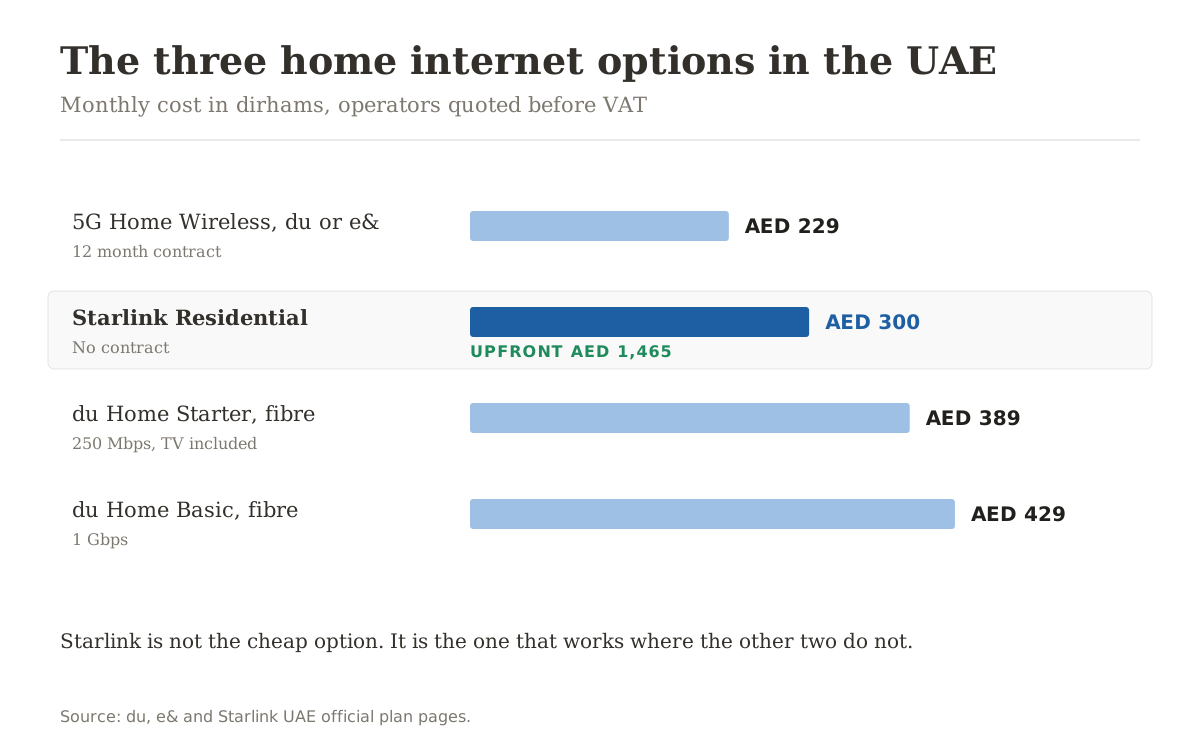
Note the VAT basis differs. The operators quote before 5 percent VAT, so AED 229 is really AED 240 and AED 389 is really AED 408.
Who should choose which
If your building is fibre ready, take fibre. Latency is better than anything wireless can do, the connection does not care about weather or line of sight, and at the higher tiers you are getting a gigabit for AED 429. Nothing here beats that.
If there is no fibre but you have decent 5G, take 5G Home Wireless at AED 229. It is the cheapest of the three, there is no hardware bill, and the router arrives ready to plug in. For most apartments and most villas in built up areas this is the answer, and it is cheaper than Starlink by AED 71 a month before you even count the AED 1,465 you did not spend.
Choose Starlink when the first two are not available to you. Land, farms, a villa in inland Ras Al Khaimah or the far side of Al Ain, a site office on a plot with nothing run to it yet, a new community handed over ahead of its infrastructure. In those places Starlink is not the cheap option, it is the only option, and AED 1,465 is what that costs.
There is one more case. Starlink has no contract. du and e& want twelve months, and e&'s Premium tier wants twenty four. If you are on a short lease, between homes, or running a site that will move, paying more per month to avoid a lock in can be the cheaper decision overall.
The catch with each
Fibre is only as good as the building. If the developer has not run it, no amount of willingness helps.
5G Home Wireless depends on the signal where the router sits, which is not the same as the signal on your phone by the window. It is also a shared medium, so a busy tower at 9pm is a slower connection.
Starlink needs sky. Trees, a tower next door or a covered balcony will cost you. Latency is higher than fibre, which you will notice on video calls and gaming and will not notice on downloads or streaming. And Starlink itself says 400 Mbps is a maximum, not a promise, and drops at peak.
Why this matters if you are buying
Fibre is a map and the map has holes. Until now, "no fibre yet" was a genuine deduction on a plot or a remote villa, because a tenant who works from home would not take it.
That deduction gets smaller now. It does not disappear, since latency still matters and AED 1,465 is still a real number, but a remote plot with a workable internet answer is a different asset from one without. If you are looking at land or a villa outside the fibre footprint, this belongs in your model rather than on your list of reasons to walk away.
My take
For most people reading this, Starlink is not the right purchase and the operators are cheaper. That is worth saying plainly, because the launch coverage did not.
What changed is narrower and more interesting. A property's internet is no longer decided purely by whether a cable reached it. For the edges of the map, and for communities handed over ahead of their infrastructure, that quietly removes an objection that used to cost real money.
Check the plan and price against your own address before committing. All three vary by location, and this article will not update itself.
Cover photo by Ka23 13, CC BY 4.0, via Wikimedia Commons.
Frequently asked questions
No. du and e& both sell 5G Home Wireless at AED 229 a month excluding VAT with the router included and no upfront hardware. Starlink is AED 300 a month plus AED 1,465 for the kit. Starlink only makes sense where fibre and 5G do not reach.
du Home Starter is AED 389 a month excluding VAT for 250 Mbps with a TV package. Home Basic is AED 429 for 1 Gbps. Both are currently discounted for the first three months.
It is sold by volume, not by month. In 1405 a gigabyte of fibre runs 2,000 to 3,300 toman depending on operator, roughly double last year, so a 200 GB month is 400,000 to 660,000 toman. International traffic is metered separately from domestic.
Between 80,000 and 150,000 toman a month as of spring 1405, with no regulated rate, so it varies by seller. After a 44 day international shutdown in April 2026 subscriptions were reported at up to 3 million toman.
No. It is not licensed there and the service is not offered. The comparison here is about cost of living, not a setup guide.
At the edges of the fibre map, yes. A remote plot or villa used to carry a discount because a work from home tenant would not take it. That discount gets smaller, though latency and the AED 1,465 mean it does not vanish.