Two of the most successful city states of the last fifty years, both built on trade, both tax-friendly by reputation, both full of foreign money. If you are deciding where to put capital into property, the reputations will not help you. The numbers will.
I made a short video about this and it travelled further than anything else I have posted, so here is the long version with the arithmetic shown.
Dubai vs Singapore at a glance
- Entry tax for a foreign buyer: about 63.5 percent in Singapore, 4 percent in Dubai.
- Gross rental yield: 3.06 percent average in Singapore at Q2 2026, against roughly 6 to 8 percent in Dubai depending on the district.
- Price per square foot: Singapore mid market around 1,550 US dollars and prime around 2,900, against about 469 in Dubai's primary market.
- Annual property tax: yes in Singapore, with a 10 percent surcharge for foreign owners. None in Dubai.
- Tax on rental income: 24 percent for non residents in Singapore. None in Dubai.
- Capital gains tax: none in either.
- Selling early: 16, 12, 8 and 4 percent seller stamp duty across the first four years in Singapore. None in Dubai.
- Residency from buying: none in Singapore. A ten year Golden Visa from AED 2 million in Dubai.
What a foreign buyer pays just to enter
This is the number that ends most of these conversations before they start.
Singapore charges every buyer a progressive Buyer's Stamp Duty, and then charges foreigners an Additional Buyer's Stamp Duty of 60 percent on top. Not 6 percent. Sixty. That rate has been in place since April 2023 and it applies whether it is your first Singapore property or your fifth.
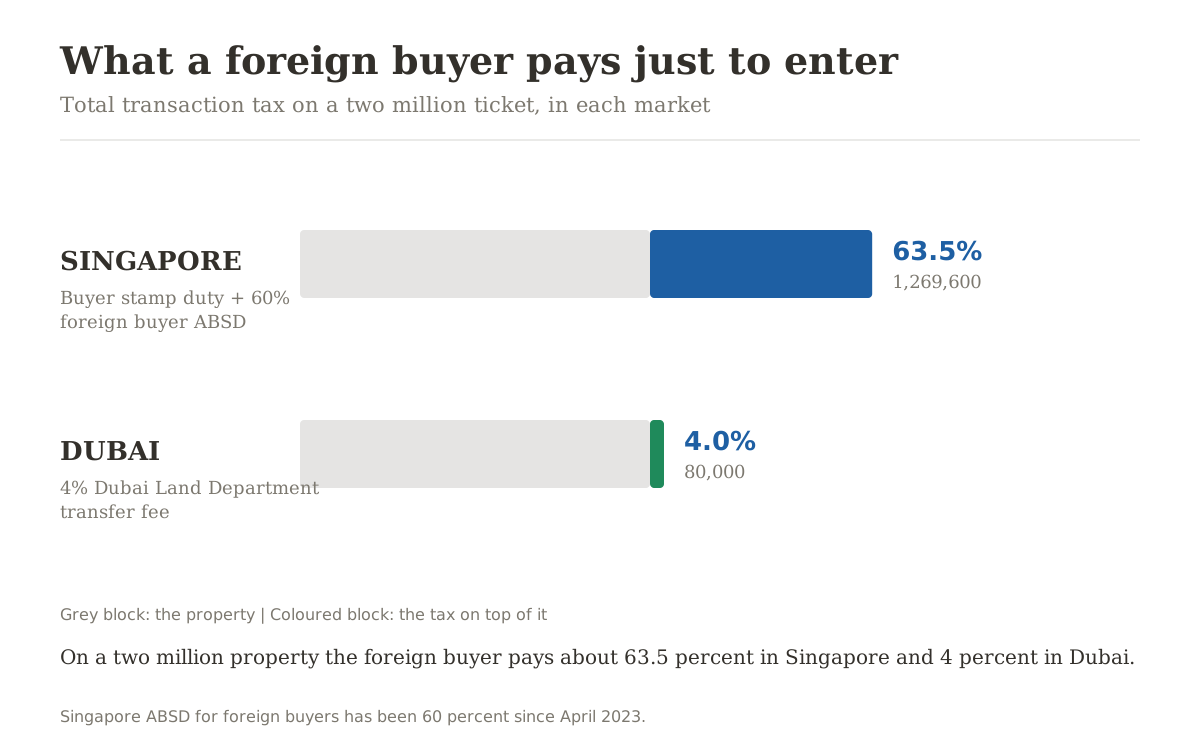
Run it on a two million property in each market's own currency:
| Singapore | Dubai | |
|---|---|---|
| Base transfer duty | 69,600 (3.48%) | 80,000 (4%) |
| Foreign buyer surcharge | 1,200,000 (60%) | none |
| Total to transact | 1,269,600 | 80,000 |
| As a share of price | 63.5% | 4.0% |
Read that bottom row twice. In Singapore the tax on the purchase is roughly sixteen times what it is here. On a two million ticket a foreign buyer hands over an extra 1.19 million before owning anything, and that money buys no floor area, no view and no rent.
There is a second consequence people miss. That 63.5 percent is sunk on day one, so your break-even moves years to the right. Before you make a single dirham of profit in Singapore you have to recover a cost equal to nearly two thirds of the asset.
Price per square foot and rental yield
The entry tax is the headline. These two are what decide whether the asset works afterwards.
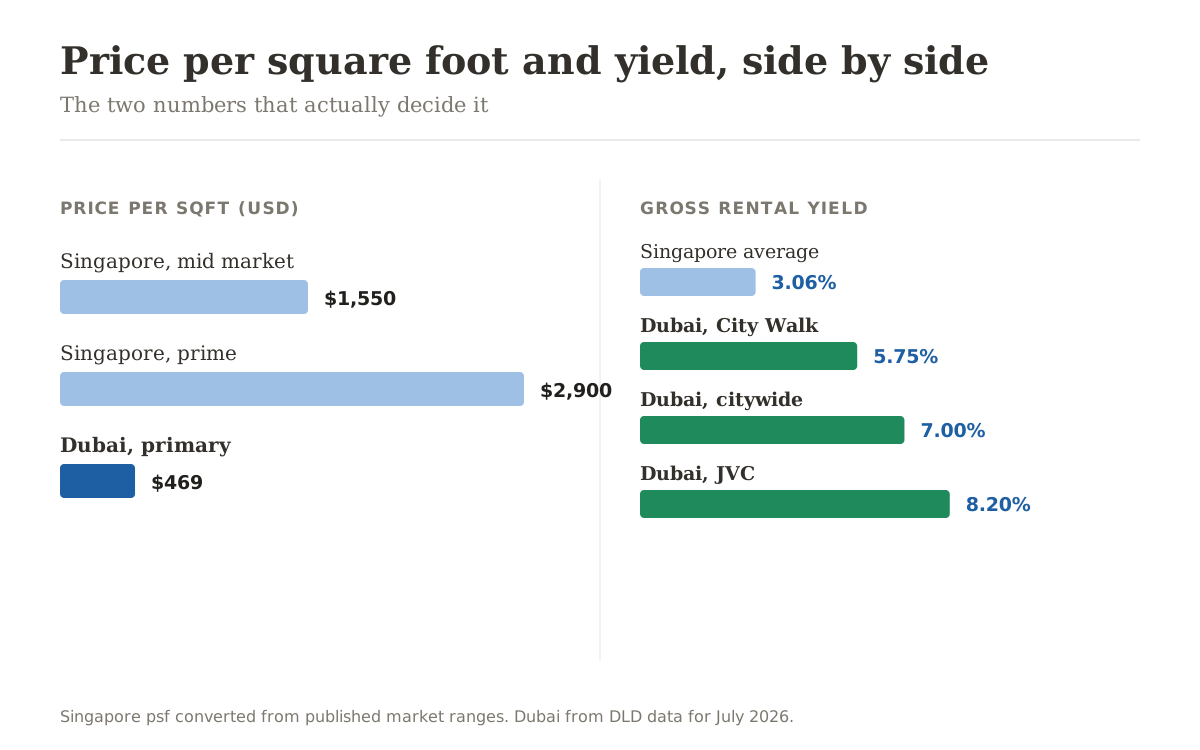
Singapore's private condo market runs roughly 1,200 to 1,800 Singapore dollars per square foot in the outer regions, 1,800 to 2,500 on the city fringe, and 2,500 to over 5,000 in the core central districts. Converted, the mid market sits near 1,550 US dollars a foot and prime near 2,900.
Dubai's primary market averaged Dh1,724 per square foot in July, about 469 US dollars. So the same money buys roughly three times the floor area here, which is exactly the claim I made in the video and it holds up.
Now the income. Singapore's average gross rental yield was 3.06 percent in the second quarter of 2026. The best sub-markets reach 4.2 to 4.8 percent and prime freehold in Orchard and River Valley sits at 2.2 to 2.7 percent.
Against that, Dubai runs roughly 6 to 8 percent gross depending on where you buy. JVC printed 8.2 percent in Q1 2026. City Walk, which is the prime, capital-preservation end of this market and the closest thing Dubai has to a Singapore-style location premium, runs 5.5 to 6 percent. In other words, our *lowest* yielding prime district still beats Singapore's average by nearly double.
Combine the two and the gap compounds: you pay about three times per square foot for less than half the income.
What you pay every year, and when you sell
Buying is one decision. Holding and exiting are the ones that quietly decide your return.
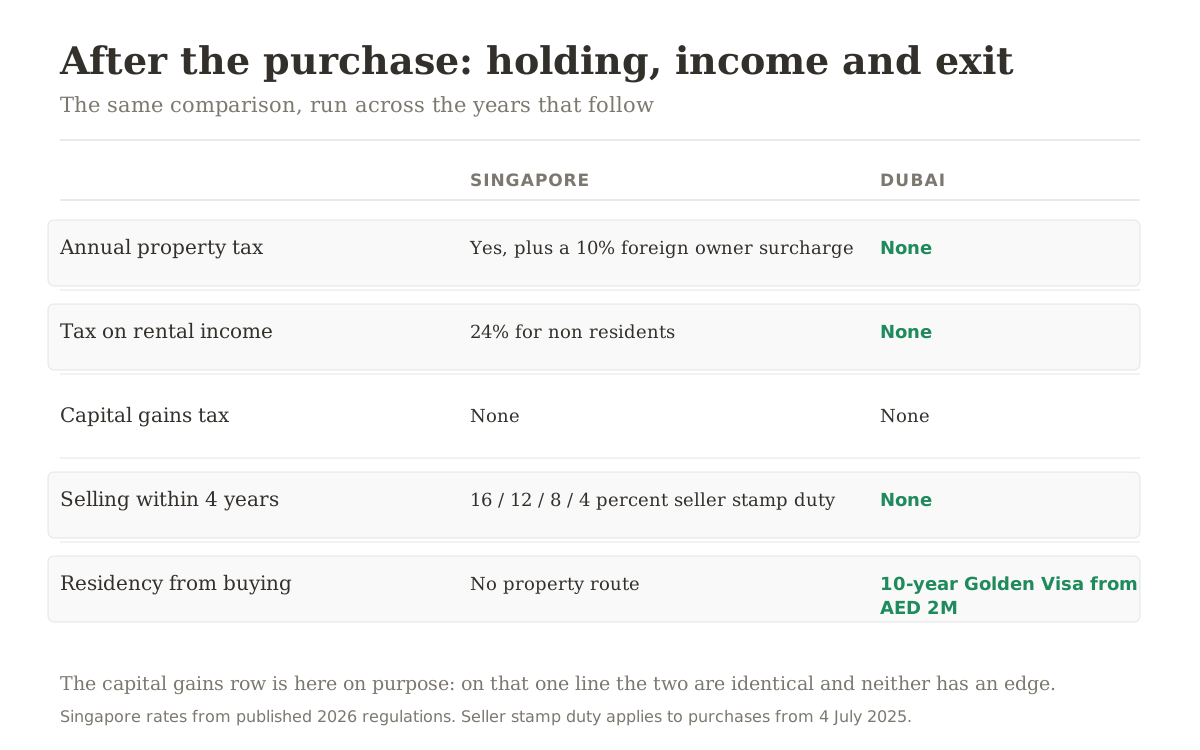
Singapore charges an annual property tax on the annual value of the home, progressive, and higher for a property you do not live in. Foreign owners pay a further 10 percent surcharge on top of that.
Rental income is taxable. A non-resident owner pays 24 percent on it. In Dubai your rent is not taxed at all, which means the yield gap in the previous section actually understates the difference once you compare what lands in your account.
And if you change your mind, Singapore charges a Seller's Stamp Duty on an early exit: for purchases from 4 July 2025 that is 16 percent in year one, 12 in year two, 8 in year three and 4 in year four. Dubai charges nothing to sell.
Where Singapore is not worse
I want to correct something, including something I said myself in the video caption.
Neither country charges capital gains tax on residential property. Dubai's zero rate is real and it is worth having, but it is not an advantage over Singapore, because Singapore does not tax capital gains either. Anyone selling you Dubai on "no capital gains tax, unlike Singapore" is either confused or hoping you are.
I am pointing that out because the honest version of this comparison is strong enough without it. The gap is 63.5 percent against 4, it is 3.06 percent against 7, and it is 24 percent income tax against zero. Those three are decisive on their own and every one of them is checkable.
Two other things in Singapore's favour, stated plainly. Its legal system and title framework are among the most respected in the world, and its currency has been one of the steadiest in Asia for decades. Neither of those shows up in a yield calculation and both are real.
Residency, the line nobody prices
Buying property in Singapore does not give you the right to live there. There is no property-linked residency route. Permanent residency runs through employment or a very large business investment programme, and a condo purchase does not open it.
In Dubai, AED 2 million of property gets you a ten year Golden Visa, renewable, covering your spouse and children.
For a family deciding where to base itself, that is not a footnote. In one market the asset is only an asset. In the other the asset is also a door. If residency has any value to you at all, it belongs in the comparison as a line with a number next to it, not as a bullet point.
The car permit that tells you the whole story
One number from outside property, because it explains the model better than anything inside it.
To own a car in Singapore you must first buy a Certificate of Entitlement at auction. In August 2026 the smaller car category closed at S$128,501 and the larger one at S$131,001. That is the permit. The car is extra.
Singapore is a small island running a deliberate policy of pricing out demand it cannot physically accommodate, and the 60 percent ABSD is the same policy applied to housing. It is not hostility to foreigners and it is not a mistake. It is a country with limited land choosing to protect it.
Dubai is doing the opposite on purpose: freehold in designated areas across all seven emirates, residency attached to ownership, no tax on the income. One is rationing. The other is recruiting. Neither is wrong, but you should know which one you are buying into.
Who should still choose Singapore
I would not send everyone here, and there are buyers I would send there.
If you are already living and working in Singapore, the ABSD calculation changes completely: citizens pay nothing on a first home and permanent residents pay 5 percent, so the 60 percent figure is a foreign-buyer number, not a Singapore number. If you want exposure to a mature Asian legal jurisdiction with a hard currency and you are buying for capital preservation over twenty years rather than income, Singapore is a serious answer. And if your business, your family or your children's schooling is there, the tax is a cost of living somewhere you were going to live anyway.
What I would not do is buy Singapore property as a pure yield investment from outside it. On the arithmetic above, that is the one case where the numbers simply do not work.
My take
The video that started this got more views than anything else I have posted, and I think the reason is that most people assume these two markets are variations on the same idea. They are not. They are opposite strategies.
If you are an investor buying from outside, this is not close. Sixty-three and a half percent against four to get in, three times the price per foot, less than half the yield, income taxed at 24 percent against zero, an exit penalty for four years against none, and no residency against a ten year visa. There is no reading of those numbers where Singapore is the better investment for a foreign buyer.
If you are choosing where to live, it is a genuinely different question and I would not pretend otherwise. Singapore is one of the best-run cities in the world. But where you live and where you invest do not have to be the same place, and the whole point of the comparison is that they no longer are for most of the people I talk to.
If you want the same arithmetic run against your own market rather than Singapore, tell me where you are buying from and I will build the comparison on your numbers.
Frequently asked questions
About 63.5 percent of the purchase price. Singapore charges a progressive Buyer's Stamp Duty, roughly 3.48 percent on a two million ticket, plus an Additional Buyer's Stamp Duty of 60 percent that applies to all foreign buyers regardless of how many properties they own. That 60 percent rate has been in place since April 2023. In Dubai the equivalent cost is the 4 percent Dubai Land Department transfer fee.
For a foreign buyer investing from outside, Dubai on every measurable line: 4 percent entry tax against 63.5, roughly a third of the price per square foot, 6 to 8 percent gross yield against a 3.06 percent Singapore average, no tax on rental income against 24 percent for non residents, no exit duty against four years of seller stamp duty, and a ten year residency visa against no property route at all. If you already live in Singapore, or you are buying for capital preservation in a mature legal jurisdiction rather than income, the answer changes.
Singapore averaged 3.06 percent gross in the second quarter of 2026, with the best sub-markets at 4.2 to 4.8 percent and prime freehold in Orchard and River Valley at 2.2 to 2.7 percent. Dubai runs roughly 6 to 8 percent gross depending on the district: JVC printed 8.2 percent in Q1 2026 and City Walk, the prime end of this market, runs 5.5 to 6 percent. Dubai's lowest yielding prime district still beats Singapore's average by close to double.
No. Singapore has no property-linked residency route. Permanent residency runs through employment or a large business investment programme, and a condo purchase does not open it. Dubai grants a renewable ten year Golden Visa on AED 2 million of property, covering spouse and children.
No, and neither does Dubai. This is the one line where the two are identical, so anyone selling Dubai on 'no capital gains tax, unlike Singapore' is wrong. Singapore does charge a Seller's Stamp Duty on early exit, however: for purchases from 4 July 2025 that is 16 percent in year one, 12 in year two, 8 in year three and 4 in year four. Dubai charges nothing to sell.
Yes. A non-resident owner pays 24 percent income tax on rental income. There is also an annual property tax on the annual value of the home, progressive and higher for a property you do not live in, with a further 10 percent surcharge for foreign owners. In Dubai rental income is not taxed and there is no annual property tax, which means the headline yield gap actually understates the difference in what reaches your account.
Singapore private condos run roughly 1,200 to 1,800 Singapore dollars per square foot in outer regions, 1,800 to 2,500 on the city fringe and 2,500 to over 5,000 in the core central districts. Converted, mid market is near 1,550 US dollars a foot and prime near 2,900. Dubai's primary market averaged Dh1,724 in July 2026, about 469 US dollars. The same money buys roughly three times the floor area in Dubai.
Because it shows the policy model. To own a car in Singapore you must buy a Certificate of Entitlement at auction: in August 2026 the smaller car category closed at S$128,501 and the larger at S$131,001, before the car itself. Singapore is a small island deliberately pricing out demand it cannot physically house, and the 60 percent ABSD is that same policy applied to property. Dubai is doing the opposite on purpose, attaching residency to ownership and taxing neither the income nor the gain.
When you already live there, since citizens pay no ABSD on a first home and permanent residents pay 5 percent, so the 60 percent is a foreign-buyer number rather than a Singapore number. Also when you want exposure to a mature Asian legal jurisdiction with a hard currency and you are buying for capital preservation over twenty years rather than income, or when your business, family or children's schooling is already there. What does not work on the arithmetic is buying Singapore property as a pure yield investment from outside it.
No. The 60 percent Additional Buyer's Stamp Duty applies to foreign buyers. Singapore citizens pay nothing on a first home and permanent residents pay 5 percent on theirs, with rates rising on subsequent properties. This is why the comparison in this article is framed for a foreign buyer specifically: it is the only group facing the full 63.5 percent entry cost.