Meraas has released Crestlane at City Walk, four buildings of 10 to 12 storeys holding 394 apartments and duplexes. One bedrooms start at AED 2.6 million and the plan is 20 percent down, 55 percent through construction and 25 percent at handover in October 2028.
The price is the conversation. At entry size that is around Dh3,368 per square foot, when the average apartment across Dubai sold at Dh1,724 per square foot in July. You are paying close to double the citywide number, and you are paying above City Walk's own average too. So the honest question is not whether Crestlane is expensive. It is whether the district is worth what it charges, and that is a question with thirteen years of evidence behind it.
Crestlane at City Walk at a glance
- Developer: Meraas. Location: City Walk, in Al Wasl, minutes from Downtown Dubai, DIFC, Business Bay and Jumeirah Beach.
- Four buildings of 10 to 12 storeys, 394 units in total.
- Unit types: 1, 2, 3 and 4 bedroom apartments, Signature 3 to 4 bedroom residences, and 4 bedroom duplexes.
- Prices from AED 2.6 million for a one bedroom, running to around AED 16.3 million for a duplex.
- Payment plan: 20 percent on booking, 55 percent during construction, 25 percent on handover.
- Handover: October 2028. Later phases carry their own dates, so confirm which one your unit sits in.
- Water features run through the scheme, with double height lobbies, private terraces and sky decks.
Crestlane price list and what the entry buys
The published entry is AED 2.6 million for a one bedroom, and the top of the range is a duplex at around AED 16.3 million. That is a six times spread inside one project, which tells you Meraas is selling to two different buyers under one name.
Do the division on the entry unit and the picture sharpens. AED 2.6 million over 772 square feet is about Dh3,368 per square foot. The larger stock prices better per foot, as it almost always does, because the fixed cost of a kitchen and bathrooms spreads across more area.
That entry number is the one to hold on to, because it is the one that gets quoted, and it is the least efficient square foot in the building.
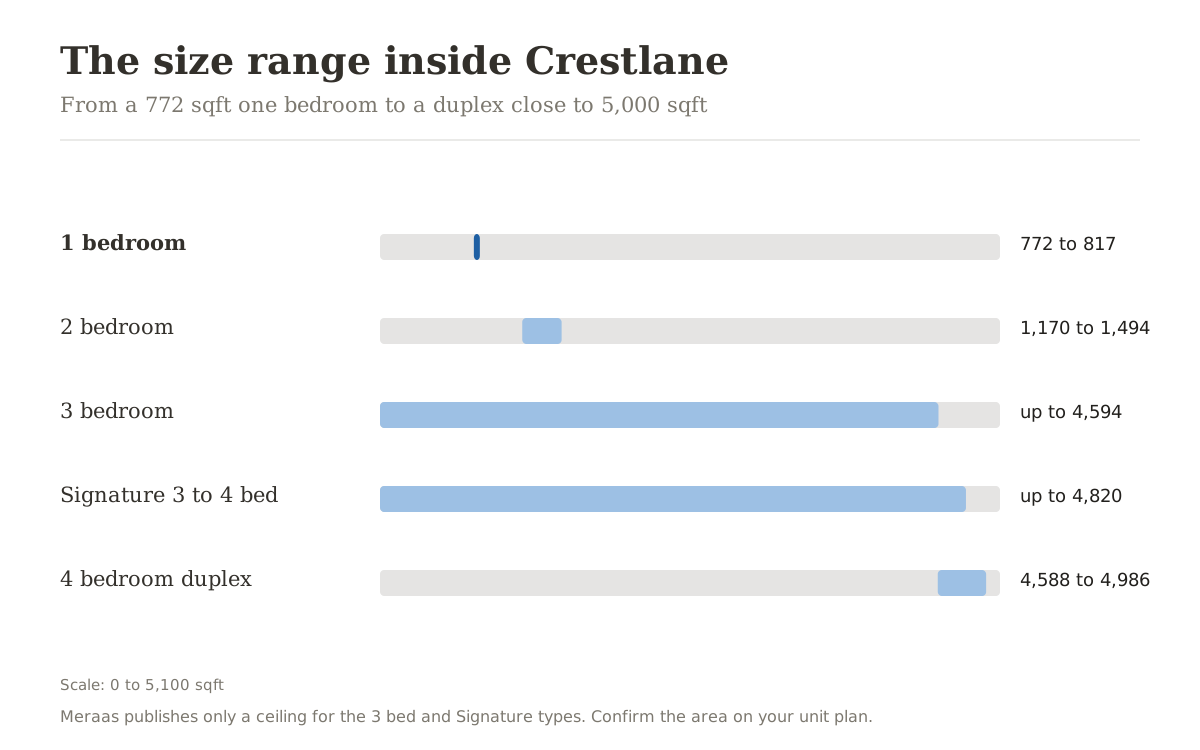
Unit sizes, from a 772 sqft one bedroom to a 4,986 sqft duplex
| Unit type | Size | Notes |
|---|---|---|
| 1 bedroom | 772 to 817 sqft | Open plan, park or skyline outlook |
| 2 bedroom | 1,170 to 1,494 sqft | Water or community outlook |
| 3 bedroom | up to 4,594 sqft | Includes a maid's room |
| Signature 3 to 4 bedroom | up to 4,820 sqft | Double height living rooms, park facing terraces |
| 4 bedroom duplex | 4,588 to 4,986 sqft | Private lift access, direct park connectivity |
Two things to note before you use that table. Meraas publishes only a ceiling for the 3 bedroom and Signature types, not a floor, so the range inside those lines is wider than it looks and the price per foot inside them will vary a lot. And the duplexes are effectively a different product living in the same buildings: private lift access and 5,000 square feet is a house, priced and marketed as an apartment.
The 20/55/25 payment plan
Twenty percent on booking, 55 percent across construction, 25 percent at handover.
This is a conventional plan and I mean that as a compliment. There is no post handover tail priced 10 percent above the standard list, which is what The Archive in DLRC charges for deferral, and no unusually light entry that hides a heavy ending, which is the shape of the Al Ghadeer Parks 55/45 plan I published alongside this. You pay a fifth to get in, most of it during the build, and a quarter at the end.
On the entry unit that is AED 520,000 on booking plus the 4 percent DLD fee of AED 104,000, so about AED 624,000 before the admin fee to hold a one bedroom. At handover you owe AED 650,000, which sits far inside what a bank will lend on a completed property. The plan does not create a financing problem, which is more than can be said for several currently on the market.
Run your own unit through the payment plan comparator before you commit.
Handover date and the phases
The main Crestlane handover is October 2028, with Crestlane 2 reported for December 2028 and later phases carrying dates of their own into 2030.
Take that seriously rather than as a footnote. Meraas is releasing this in numbered phases, and "Crestlane" in a broker listing may mean any of them. A two year difference in handover changes your holding cost, your first letting date and your exit window. Get the phase number and the contractual completion date on the same page as the price, in writing.
Amenities at Crestlane
- Padel and tennis courts
- Infinity edge and beach style swimming pools, with dedicated kids and family areas
- Glass walled yoga studio overlooking the water features
- Cardio and weights studios
- Indoor and outdoor community lounge with sunken seating
- Jogging and cycling tracks built into the landscape
- Double height lobbies, private terraces and sky decks
Worth saying plainly: none of this is unusual at this price point. Every prime Dubai launch has a pool, a gym and a padel court now. The amenity list is not the reason to buy here. The district is.
Why City Walk works, and what the design actually does
This is the part I would want a buyer to understand, because it is the thing being paid for.
Meraas launched City Walk in 2013 in Al Wasl, and the decision that defined it was a refusal. Dubai's default is the tower on a podium: you arrive by car, park underneath, ride a lift, and the street outside is a road. City Walk was built as a low rise, European style pedestrian grid instead. Tree lined boulevards, open plazas, buildings that meet the pavement, retail at street level rather than in a mall box.
The design idea underneath it is that the space between buildings matters as much as the buildings. That sounds like a brochure line and it has a measurable consequence: it makes the district walkable in a city where walkable is rare. Over a million square feet of retail sits at ground level along those streets, and the district carries anchors that pull people in from outside it, Coca-Cola Arena and The Green Planet among them. Phase Two added Central Park, 230,000 square metres of park with mid rise buildings around it rather than towers.
The reason that matters commercially is scarcity. Dubai can build another tower district whenever it wants and frequently does. It cannot easily build another low rise pedestrian district in Al Wasl, because the land is finished and the format does not fit anywhere obvious. Supply in this typology is effectively capped, and that cap is what has held the pricing.
There is a second effect that shows up in the letting market. A district with cafes, a park and an arena inside walking distance holds a tenant who could otherwise live anywhere. That tenant is usually a professional couple or a single person on a strong salary, and they renew, which is worth more to a landlord than a higher headline rent with annual voids.
What City Walk has already done
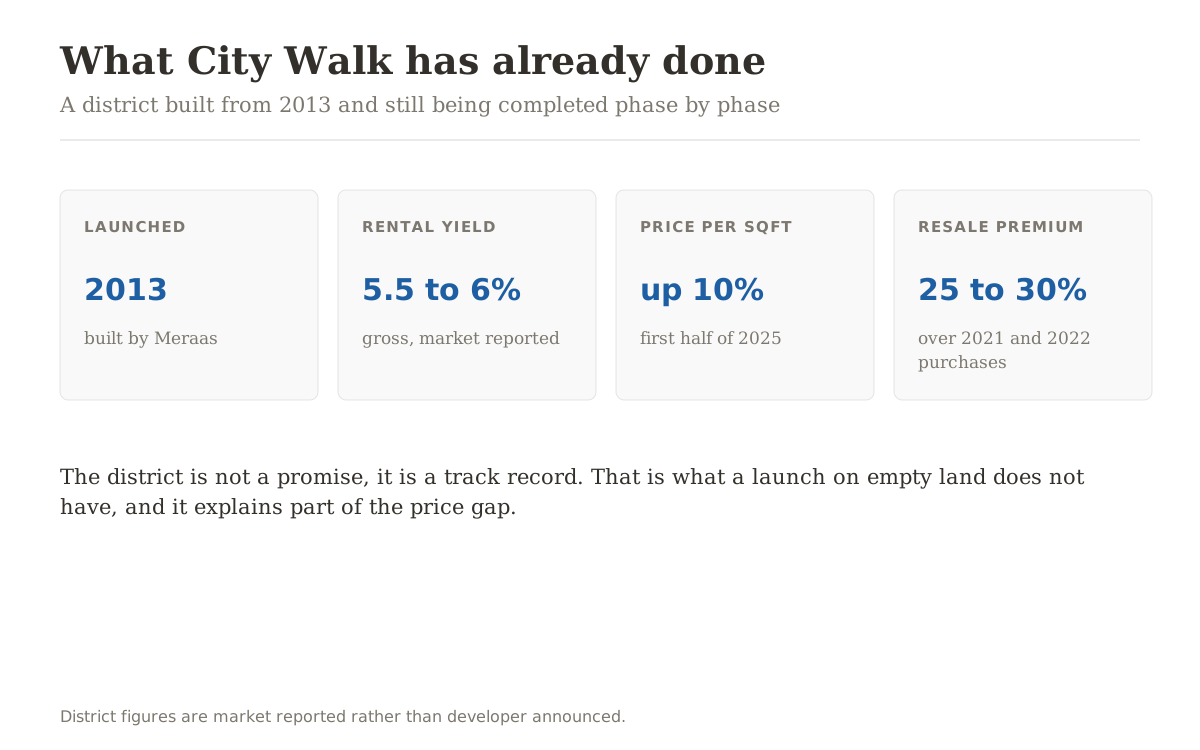
On market reported figures: the district averages around Dh3,100 per square foot, gross rental yields run 5.5 to 6 percent, price per square foot rose about 10 percent through the first half of 2025, and sellers in the secondary market have been achieving premiums of 25 to 30 percent over their 2021 and 2022 purchase prices.
Read the last one carefully, because it is the most useful and the most easily misread. A 25 to 30 percent gain over four to five years is a real return and it is not a spectacular one; annualised it is mid single digits. What it demonstrates is not explosive growth. It is that the district holds value and that an exit exists, which is precisely what a buyer at this price point should be buying.
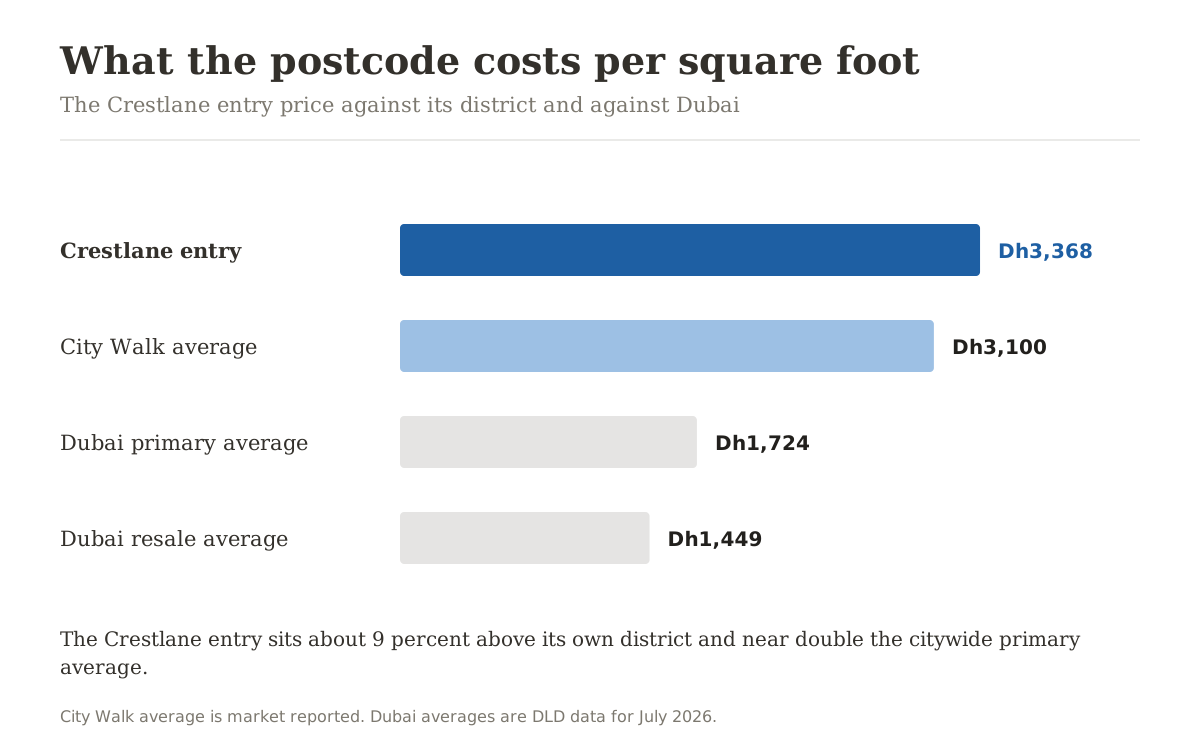
What the postcode costs per square foot
| Benchmark | Price per sqft |
|---|---|
| Crestlane entry unit | about Dh3,368 |
| City Walk average | about Dh3,100 |
| Dubai primary apartments, July 2026 | Dh1,724 |
| Dubai resale apartments, July 2026 | Dh1,449 |
So there are two premiums stacked here, and it is worth separating them. The first is the district premium: City Walk at Dh3,100 against a citywide primary average of Dh1,724, which is roughly 80 percent. That premium is old, it is documented, and the resale evidence says the market pays it.
The second is the new build premium inside the district: Crestlane's entry at about 9 percent over the City Walk average. That is the one to interrogate, because you are paying it for a building that does not exist yet in a district that already does. Ask what a comparable finished one bedroom in City Walk trades at today. If the gap is 9 percent for a 2028 handover, that is a reasonable ask. If it is materially wider on the unit you are shown, the secondary market is your better route in. The citywide figures come from my July 2026 market report.
The rental case, and what you give up
At 5.5 to 6 percent gross, City Walk is not a yield play, and anyone selling it to you as one is selling the wrong thing.
For scale: the same money in Dubailand Residence Complex is currently printing around 9 percent gross, and Al Ghadeer on the Abu Dhabi border runs 8 to 8.5 percent. You are giving up roughly three percentage points of income to be here. Over ten years on a AED 2.6 million purchase that is a large number.
What you get back is the other half of total return, and it is not nothing. A district with a thirteen year record, a capped supply format, tenants who renew, and a secondary market deep enough that sellers actually clear at a premium. Prime central stock is a capital preservation asset. Outer district stock is an income asset. They are different instruments and the mistake is buying one while measuring it against the other.
Net yield will be lower again once service charges come out, and prime low rise districts carry high ones. See what service charges really cost, and put your own unit through the net yield calculator rather than accepting a gross figure.
What I would check before booking
- Confirm the phase. Crestlane, Crestlane 2 and the later releases carry different completion dates, and a broker listing may not distinguish them.
- Get the service charge estimate in writing. It is the line that moves your net yield most, and this amenity load is not light.
- Ask what a finished comparable one bedroom in City Walk trades at today, and compare it against the Crestlane entry. That single comparison tells you whether the new build premium is fair.
- Confirm the exact size of your unit, particularly on the 3 bedroom and Signature lines where only a ceiling is published.
- On the duplexes, check the parking allocation and lift arrangement, because a 5,000 sqft home with apartment parking is a resale problem.
- Ask what percentage must be paid before Meraas issues an NOC for resale, if an exit before handover is part of your plan.
My take
I would buy in City Walk for what it is and I would not pretend it is something else.
It is one of the few genuinely walkable districts in Dubai, built deliberately against the local default, in a format the city cannot easily replicate. That scarcity is real and the market has been paying for it since 2013. If you want to live in central Dubai and step out of your door into somewhere rather than onto a road, the list of alternatives is short, and this is on it.
What I would not do is underwrite it on yield. Five and a half to six percent is the honest number, it is well below what the same capital earns thirty minutes away, and if the pitch you are hearing involves short term letting to close that gap, ask about the building's short term rental rules before you assume it.
The specific thing I would check hardest is the 9 percent gap between the Crestlane entry and the City Walk average. Nine percent for a 2028 handover in a proven district is defensible. It is also a number that moves between phases and between units, and the finished stock next door is the benchmark that keeps everyone honest.
If you want the current phase, the release price on a specific unit and what comparable finished stock in City Walk is actually trading at, send me the details and I will put both numbers next to each other.
Frequently asked questions
Crestlane is an off plan residential release by Meraas inside City Walk, Dubai. It is four buildings of 10 to 12 storeys holding 394 units: 1 to 4 bedroom apartments, Signature 3 to 4 bedroom residences and 4 bedroom duplexes. Prices start at AED 2.6 million, the plan is 20/55/25 and the main handover is October 2028.
One bedrooms start at AED 2.6 million and duplexes run to around AED 16.3 million. At entry size the price works out at about Dh3,368 per square foot, against a City Walk average of roughly Dh3,100 and a Dubai primary apartment average of Dh1,724 in July 2026. Larger units price better per square foot than the entry stock.
Twenty percent on booking, 55 percent during construction and 25 percent on handover. On the entry unit that is AED 520,000 on booking plus the 4 percent DLD fee of AED 104,000, so about AED 624,000 before the admin fee. The AED 650,000 due at handover sits comfortably inside what a bank will lend on a completed property, so the plan does not create a financing gap.
The main Crestlane handover is October 2028, with Crestlane 2 reported for December 2028 and later phases carrying dates of their own into 2030. Meraas is releasing this in numbered phases, so confirm which phase your unit is in and get the contractual completion date in writing alongside the price.
One bedrooms are 772 to 817 sqft and two bedrooms 1,170 to 1,494 sqft. Three bedrooms are published as up to 4,594 sqft including a maid's room, Signature 3 to 4 bedroom residences up to 4,820 sqft, and 4 bedroom duplexes 4,588 to 4,986 sqft with private lift access. Meraas publishes only a ceiling for the 3 bedroom and Signature types, so confirm the exact area on your unit plan.
Because it was built against Dubai's default. Meraas launched it in 2013 in Al Wasl as a low rise, European style pedestrian grid rather than towers on podiums: tree lined boulevards, open plazas, buildings meeting the pavement and over a million square feet of retail at street level. It is genuinely walkable in a city where walkable is rare, and anchors like Coca-Cola Arena and The Green Planet draw people in from outside the district.
Around 5.5 to 6 percent gross on market reported figures. That is well below outer districts: Dubailand Residence Complex currently prints around 9 percent and Al Ghadeer on the Abu Dhabi border 8 to 8.5 percent. City Walk is a capital preservation asset rather than an income one, and net yield falls further once service charges come out.
On market reported figures, sellers have been achieving premiums of 25 to 30 percent over their 2021 and 2022 purchase prices, and price per square foot rose about 10 percent through the first half of 2025. Annualised, 25 to 30 percent over four to five years is a mid single digit return: not explosive growth, but evidence that the district holds value and that an exit exists.
At the entry unit, yes, by roughly 9 percent: about Dh3,368 per square foot against a district average near Dh3,100. There are two premiums stacked here, the district premium of about 80 percent over the citywide primary average, and the new build premium inside the district. The second is the one to interrogate. Ask what a comparable finished one bedroom in City Walk trades at today.
Padel and tennis courts, infinity edge and beach style swimming pools with dedicated kids and family areas, a glass walled yoga studio overlooking the water features, cardio and weights studios, an indoor and outdoor community lounge with sunken seating, and jogging and cycling tracks in the landscape. Residences carry double height lobbies, private terraces and sky decks.
City Walk sits in Al Wasl, minutes from Downtown Dubai, DIFC, Business Bay and Jumeirah Beach, with direct links to Sheikh Zayed Road. Inside the district are over a million square feet of retail, Central Park at 230,000 square metres added in Phase Two, Coca-Cola Arena and The Green Planet.
It depends what you are buying it for. As a capital preservation asset in one of the few genuinely walkable central Dubai districts, with a thirteen year record and a supply format the city cannot easily replicate, the case is strong. As a yield play it is not: 5.5 to 6 percent gross is roughly three percentage points below what the same capital earns in outer districts. Buy it for the location and the liquidity, not the income.