Dubai has spent decades running on the annual rent cheque. Two changes are now unpicking that, and they are not the same thing, even though the coverage tends to blur them together. One is live today. The other is announced and not open yet. The difference matters, because only one of them can help you this month.
Here is what each actually is, worked through on a real number, and how both compare to the private companies that have been doing this for years and charging for it.

What Flexi Rent is, and it is live now
Flexi Rent is a Dubai Land Department initiative that went live on 23 June 2026. It is not a loan and there is no bank in it. It simply widens what a tenancy contract is allowed to look like, so a property management company can agree to take your rent in instalments instead of one or two cheques.
The options are monthly, quarterly, or semi-annual, and which of them you can actually get depends on the company you are renting from.
- Participation is voluntary. No landlord or management company is obliged to offer it.
- It covers apartments, villas, offices and retail units.
- It is for UAE residents and visa holders with valid residency documentation.
- The tenancy has to be at least 12 months.
- Whatever you agree gets written into the tenancy contract itself, and the company keeps managing the contract and the payments.
Getting it is three steps: approach a participating management company, pick the schedule you want, and have the agreed terms put into the contract.
The Land Department publishes no fee for this, because there is nothing to charge for. It is a payment schedule, not a credit product. The cost, if there is one, shows up somewhere else, and I will come back to that because it is the part most people miss.
What Rent Now, Pay Later adds, and it is not open yet
This is the one that got the headlines, and it is worth being precise: as of publication it has been announced for September 2026 and is not yet running.
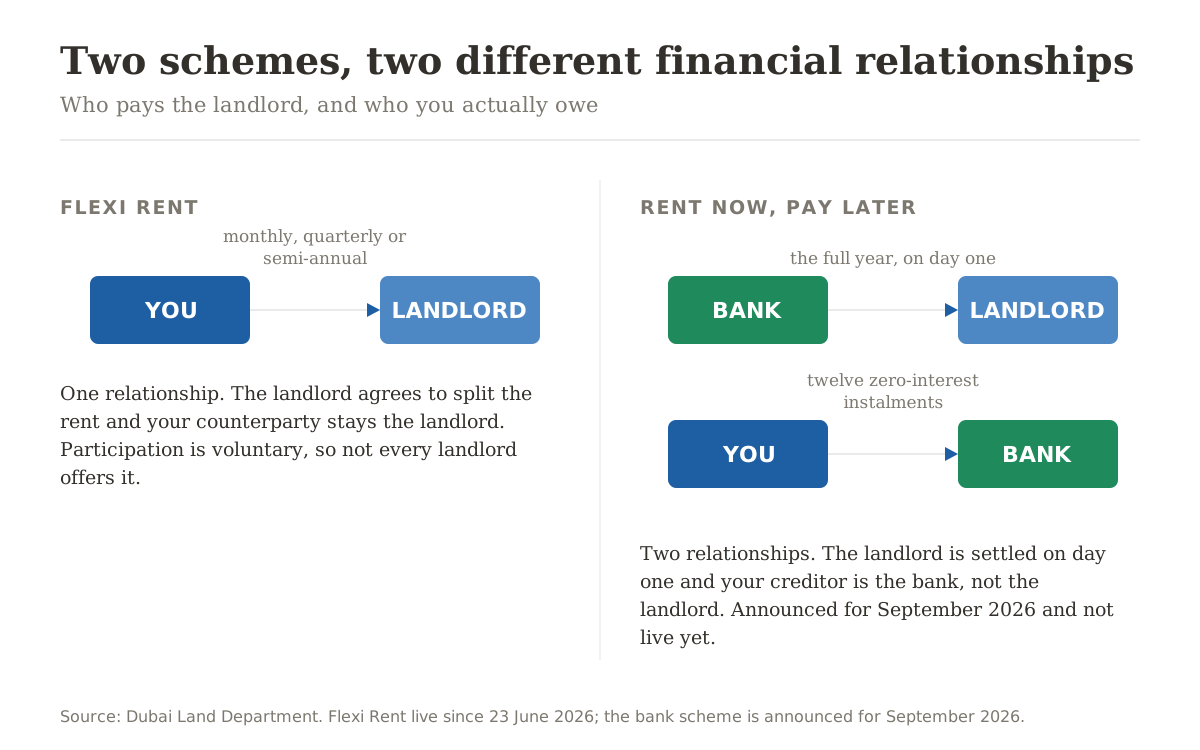
The mechanism is different in kind, not just in degree. You pick a property, a participating bank pays your landlord the entire annual rent, and you then repay the bank across up to 12 monthly instalments with no interest. The Land Department has described it as potentially the first arrangement of its type by a city anywhere.
The difference that actually matters
Both let you pay monthly. That is where the similarity ends.
Under Flexi Rent your landlord waits for their money, and you still owe your landlord. Under Rent Now, Pay Later your landlord is paid in full on day one, and you owe a bank instead. One relationship becomes two.
That single change has a consequence nobody in the coverage has spelled out. Dubai landlords have always priced cheques: one cheque buys the lowest annual rent, and every extra cheque tends to nudge that number up, because the landlord is giving up cash certainty. Under Flexi Rent you are asking the landlord to accept twelve payments, so you should expect the quoted annual rent to reflect that. Under the bank scheme the landlord receives the whole year at once, which is the single-cheque outcome from their side, so you are in a position to ask for single-cheque pricing while still paying monthly yourself.
| Flexi Rent | Rent Now, Pay Later | |
|---|---|---|
| Status | Live since 23 June 2026 | Announced for September 2026 |
| Who pays the landlord | You, in instalments | A participating bank, in full, upfront |
| Who you owe | The landlord | The bank |
| Schedules | Monthly, quarterly, semi-annual | Up to 12 monthly |
| Stated cost | None. It is a schedule | Zero interest. Admin fees not yet announced |
| Depends on the landlord agreeing | Yes, participation is voluntary | The property must be with a participant |
| Likely credit check | No | Yes, it is a bank facility |
AED 120,000 a year, worked through
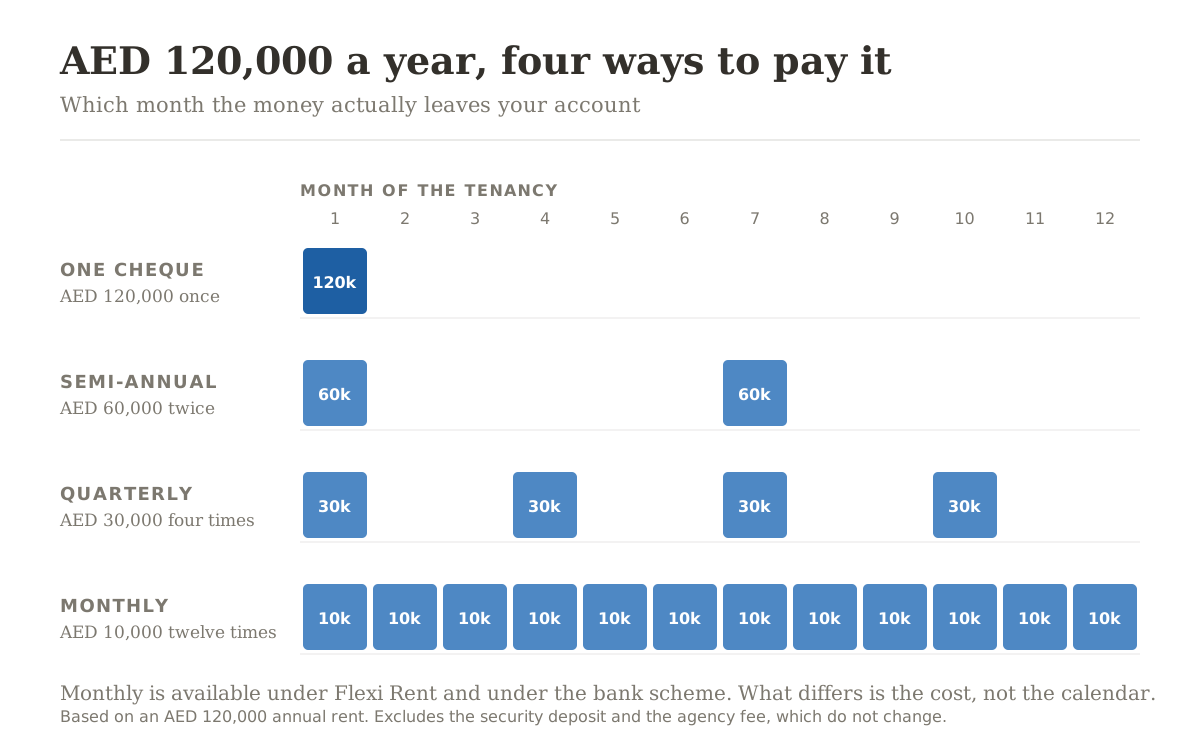
Take a one bedroom at AED 120,000 a year, which is a realistic mid-market Dubai figure. Here is when the money leaves your account under each schedule.
| Schedule | Each payment | How many | Cash needed in month one |
|---|---|---|---|
| One cheque | AED 120,000 | Once | AED 120,000 |
| Semi-annual | AED 60,000 | Twice | AED 60,000 |
| Quarterly | AED 30,000 | Four times | AED 30,000 |
| Monthly, either scheme | AED 10,000 | Twelve times | AED 10,000 |
The number worth staring at is the last column. Moving from one cheque to monthly takes your day-one requirement from AED 120,000 to AED 10,000. On the same flat. That is the entire point of both schemes, and it is a genuinely large change for anyone whose salary arrives monthly, which is almost everyone.
What does not change: the security deposit, normally 5 percent, and the agency fee, normally 5 percent, are still due at the start. Neither government scheme addresses those. On AED 120,000 that is AED 12,000 you still need upfront regardless.
What the flexibility costs
This is where the schemes separate from the private market, and the gap is not small.
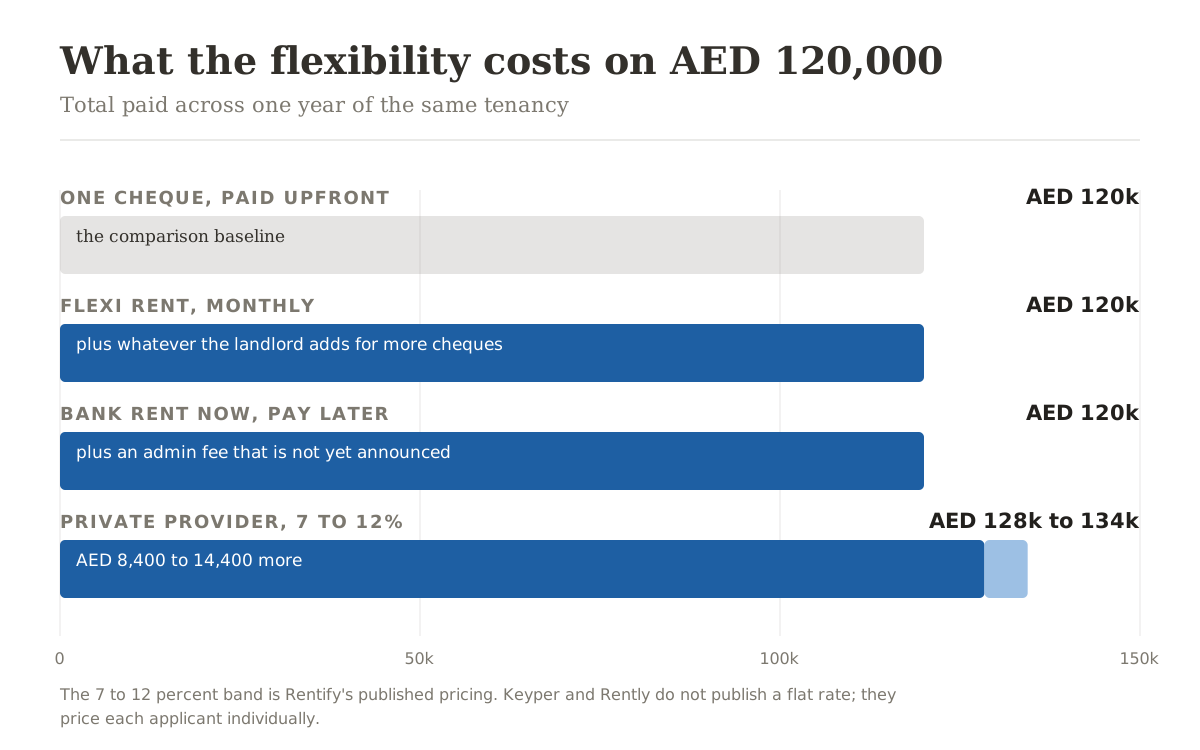
Under Flexi Rent the scheme itself costs nothing. Your exposure is whatever the landlord adds to the annual rent for accepting twelve payments instead of one, which is negotiable and varies by landlord.
Under Rent Now, Pay Later the instalments are interest free. Administrative or processing charges have not been disclosed, so the honest answer on total cost is that we do not know it yet.
The private providers charge a real fee. Rentify publishes its band as 7 to 12 percent of annual rent, depending on credit profile and payment structure, and gives the worked example of a tenant on AED 70,000 paying roughly AED 7,000 extra across the year. Applied to our AED 120,000 tenant, 7 to 12 percent is AED 8,400 to AED 14,400 on top of the rent, so AED 10,700 to AED 11,200 a month instead of AED 10,000.
One point of precision, because it gets misreported: that 7 to 12 percent band is Rentify's published pricing. Keyper and Rently do not publish a flat rate. Rently describes a personalised service fee set from your application, and Keyper's site markets instant approval and zero upfront cost without disclosing a fee at all. You cannot know your cost with either until you apply, which is itself worth weighing.
How the schemes compare to Keyper and Rently
Keyper and Rently solve the same problem the government schemes are now aiming at, and they have been doing it for a while. Both pay your landlord and collect from you monthly by card. Rently pays the annual rent in the cheques the lease actually requires, whether that is one, two, three or four. Keyper splits your rent into twelve card payments and can spread the security deposit across the first three.
Where the private providers are genuinely better:
- They work now. Rent Now, Pay Later does not exist yet, and Flexi Rent needs your landlord to have opted in.
- They do not need the landlord's cooperation. They pay the landlord in the format the landlord already wanted, so a landlord who refuses instalments is not an obstacle.
- Rently operates across Dubai, Abu Dhabi, Sharjah, Ajman and Ras Al Khaimah. Flexi Rent is a Dubai Land Department initiative and applies to Dubai.
- Both can finance the security deposit. Neither government scheme touches it, and the deposit is a real part of the upfront problem.
- Approval is fast and app based, and card payment can earn you rewards on spend you were making anyway.
Where they are worse:
- Cost. On AED 120,000, a 7 to 12 percent fee is AED 8,400 to AED 14,400 a year that a zero-interest facility would not charge. That is the whole argument.
- Pricing is opaque. A personalised fee you only learn after applying makes it hard to compare against anything.
- There are edge charges. Keyper notes a fee for changing your payment schedule later and a late fee if a payment fails.
- It is a credit facility with underwriting, and it sits outside the tenancy contract rather than inside it.
What we still do not know
I would rather flag the gaps than paper over them. For Rent Now, Pay Later, the Land Department has not yet announced the eligibility criteria, the application process, the required documents, which banks are participating, or the precise repayment terms. Whether a processing fee applies, and how large, is the single biggest open question, because it decides whether the scheme actually undercuts the private providers or merely matches them.
Treat any figure you see for the bank scheme's total cost as speculation until the launch details are published.
What I tell tenants
- If your landlord will do monthly under Flexi Rent at the same annual rent, take it. That is the cheapest outcome available and it costs you nothing.
- If the landlord wants a premium for monthly, price it. A 4 percent bump on AED 120,000 is AED 4,800, which is still well under a 7 to 12 percent finance fee.
- If you can wait until the bank scheme opens, waiting is probably worth real money. Zero interest against 7 to 12 percent is a wide gap.
- If you need this now, or you need the deposit financed, or you are renting outside Dubai, the private providers are your only route, and you are paying for the convenience. Get the exact fee in writing before you sign.
- Whichever route you take, work out whether you should be renting at all. Five years in the same community usually favours owning, and my rent or buy calculator will tell you where your break-even sits.
Know your renewal position too, because none of this changes your rights: the RERA rental index governs what a landlord can raise at renewal, and paying monthly does not alter that.
Sources: the Dubai Land Department Flexi Rent initiative page, Gulf News on the Rent Now Pay Later scheme, and Khaleej Times on the cost of paying rent monthly. Provider details from Keyper and Rently's own published material. Figures current at publication, 16 August 2026.
Frequently asked questions
Flexi Rent is a Dubai Land Department initiative live since 23 June 2026 that lets a property management company take your rent in monthly, quarterly or semi-annual instalments instead of one or two cheques. There is no bank and no loan: it widens what a tenancy contract may contain, and the agreed schedule is written into the contract itself. Participation is voluntary, it covers apartments, villas, offices and retail, it requires a tenancy of at least 12 months, and it is for UAE residents and visa holders with valid residency documentation.
It has been announced for September 2026 and is not open yet. As of August 2026 the Dubai Land Department has not published the eligibility criteria, the application process, the required documents, which banks are participating, or the precise repayment terms. Whether a processing fee applies, and how large it is, is still unannounced. Treat any total-cost figure for the scheme as speculation until launch details are published.
Who pays your landlord, and who you owe. Under Flexi Rent you pay the landlord in instalments and the landlord waits for the money, so your counterparty stays the landlord and there is no credit check. Under Rent Now, Pay Later a participating bank pays the landlord the whole annual rent on day one and you repay the bank across up to 12 interest-free monthly instalments, so your creditor is a bank and underwriting applies. Because the landlord receives the full year at once, the bank route also puts you in a position to ask for single-cheque rent pricing while still paying monthly.
On an AED 120,000 annual rent, monthly means AED 10,000 twelve times instead of AED 120,000 once, which cuts the day-one requirement from AED 120,000 to AED 10,000. Flexi Rent charges nothing for the schedule itself; your only exposure is whatever the landlord adds to the annual rent for accepting twelve payments. The bank scheme is interest free with admin fees not yet announced. A private provider charging 7 to 12 percent would add AED 8,400 to AED 14,400 a year, so AED 10,700 to AED 11,200 a month. The security deposit and agency fee, roughly AED 12,000 together, are still due upfront either way.
On cost, an interest-free facility should beat a paid one, and Flexi Rent charges nothing for the schedule at all. But be precise about the comparison: the widely quoted 7 to 12 percent band is Rentify's published pricing, not Keyper's or Rently's. Rently sets a personalised service fee from your application and Keyper does not publish a fee, so with either you cannot know your cost until you apply. The private providers still win on availability: they work today, they do not need the landlord to participate because they pay in the cheque format the lease already requires, both can finance the security deposit, and Rently covers Dubai, Abu Dhabi, Sharjah, Ajman and Ras Al Khaimah rather than Dubai alone.